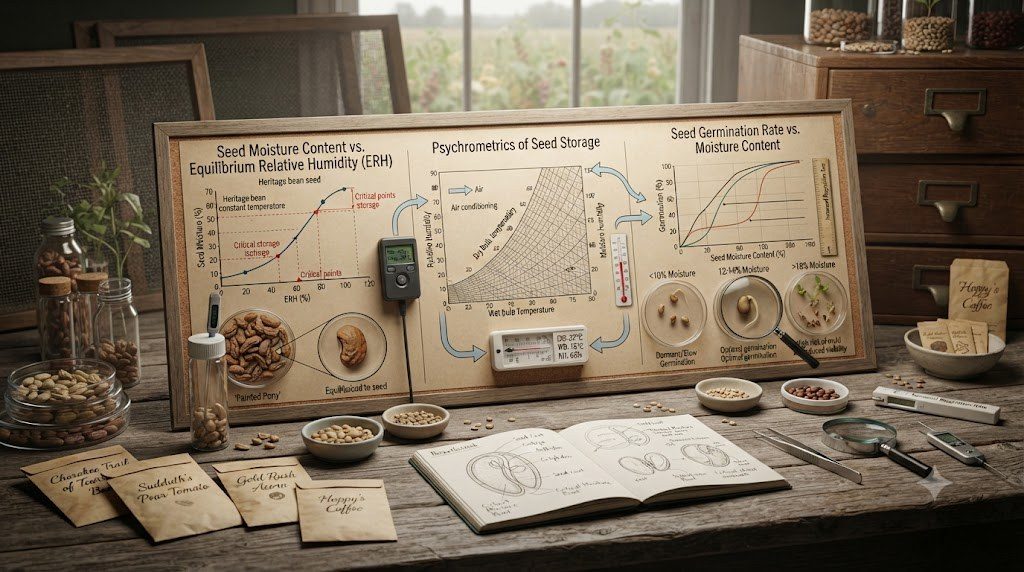
In the physical and biological sciences of seed preservation, no single abiotic factor exerts greater control over post-harvest longevity and biochemical stability than moisture. A seed is not a sealed dry capsule; it is an open, hygroscopic biological system that continuously exchanges water vapor with the ambient atmosphere until reaching thermodynamic equilibrium. The relationship between seed moisture content (SMC), ambient equilibrium relative humidity (eRH), and water activity (a_w) dictates every fundamental biochemical reaction occurring within the seed matrix—from enzymatic hydrolysis and respiration to lipid peroxidation and macromolecular glass formation.
Managing seed moisture requires far more than basic dehydration; it demands a granular understanding of sorption isotherms, hysteresis phenomena, psychrometric dew points, and the precise boundary lines dividing bound structural water from destructive free metabolic water. Whether managing commercial agricultural warehouses, long-term germplasm vaults, or decentralized community seed banks, failing to measure and manipulate water activity correctly results in rapid seed aging, mitochondrial degradation, and catastrophic loss of germination vigor. This comprehensive treatise explores the thermodynamic principles, psychrometric equations, moisture determination methodologies, and sorption behavior of orthodox seeds.
1. Water Activity vs. Moisture Content: The Thermodynamic Distinction
In seed technology, a critical distinction must be drawn between Moisture Content (MC) and Water Activity (a_w):
- Seed Moisture Content (MC): Represents the quantitative mass of water present in a seed, expressed as a percentage of either total fresh weight (Wet Basis, % WB) or dry seed matter (Dry Basis, % DB). While moisture content measures water quantity, it provides zero information regarding how tightly that water is bound to cellular molecules or how chemically reactive it is.
- Water Activity (a_w) & Equilibrium Relative Humidity (eRH): Defines the chemical potential or energy status of water within the seed matrix. Water activity is mathematically defined as the ratio of the vapor pressure of water in the seed (p) to the vapor pressure of pure water (p0) at the exact same temperature: a_w = p / p0. When a seed achieves thermodynamic equilibrium with its surrounding gaseous headspace, its water activity directly mirrors the ambient relative humidity: eRH = a_w × 100%.
Two seed lots possessing identical moisture contents can exhibit wildly disparate water activities depending on their biochemical composition. An oily seed (such as canola or sunflower, containing 45% hydrophobic lipids) will exhibit a dangerous water activity of 0.70 at only 8% moisture content, whereas a starchy cereal (such as wheat or barley, rich in hydrophilic starch hydroxyl groups) remains at a completely safe water activity of 0.45 at that exact same 8% moisture content.
2. Sorption Isotherms and Hysteresis Dynamics
The relationship between seed moisture content and equilibrium relative humidity at a constant temperature is graphically depicted by a Moisture Sorption Isotherm. For virtually all agricultural seeds, this isotherm follows a characteristic sigmoidal (S-shaped) curve categorized by three distinct thermodynamic hydration regions (Zones I, II, and III).
Crucially, seeds exhibit sorption hysteresis: at any given relative humidity, a seed that is losing moisture through desorption (drying) retains a higher moisture content than a seed that is gaining moisture through adsorption (wetting). This occurs because during drying, hydrophilic hydroxyl and amino binding sites on starch and protein polymers collapse inward and bond with each other. Upon re-wetting, these sites are physically shielded and cannot immediately re-bind water molecules without significant swelling. Consequently, drying protocols and seed testing labs must always specify whether moisture values were derived from desorption or adsorption cycles.
3. Harrington’s Thermodynamic Rule vs. Modern Psychrometrics
In 1972, seed physiologist James Harrington introduced his celebrated agricultural guidelines: for every 1% decrease in seed moisture content, seed storage life doubles; and for every 5°C decrease in storage temperature, storage life doubles. While brilliant as a general field rule, modern psychrometric science reveals that Harrington’s rule breaks down completely at the extremes.
Below 5% moisture content (corresponding to water activity below 0.15), water molecules are stripped from the structural hydration shells of functional enzymes. This induces ‘over-drying injury’ characterized by lipid peroxidation and cracking. Conversely, above 14% moisture content, free water enables rapid mitochondrial respiration, rendering the doubling rule mathematically invalid.
Modern seed banks rely instead on psychrometric charts and water activity meters. By controlling ambient relative humidity (typically 15% RH at 15°C for pre-drying, followed by hermetic sealing at 3% to 6% moisture content for -20°C storage), seed banks achieve maximum vitrification without inducing desiccation shock.
| Crop Species | Seed Composition Type | Moisture Content at 30% eRH | Moisture Content at 65% eRH (Safe Limit) | Critical Mold Threshold (> 75% eRH) |
|---|---|---|---|---|
| Wheat / Barley (Cereals) | High Starch (> 65%) | 8.5% – 9.2% | 13.0% – 13.5% | > 15.0% (Rapid heating & mold) |
| Canola / Mustard (Oilseeds) | High Lipid (> 42%) | 5.0% – 5.5% | 7.8% – 8.2% | > 9.5% (Lipase rancidity) |
| Soybean (Oil / Protein) | Balanced Protein / Lipid | 6.2% – 6.8% | 11.0% – 11.5% | > 13.0% (Cotyledon browning) |
| Garden Pea / Bean (Legumes) | High Protein & Starch | 8.0% – 8.6% | 13.2% – 13.8% | > 15.5% (Seed coat rupture) |
| Onion / Leek (Allium) | High Essential Oil / Lipid | 6.0% – 6.5% | 9.5% – 10.0% | > 11.5% (Rapid vigor collapse) |
| Tomato / Pepper (Solanaceae) | Moderate Lipid & Fiber | 6.5% – 7.0% | 10.0% – 10.5% | > 12.0% (Embryo senescence) |
4. Moisture Determination Methodologies: ISTA Oven Protocols
Accurate quantification of seed moisture content is mandatory for certified seed trade. The International Seed Testing Association (ISTA) establishes strict, standardized laboratory protocols to prevent analytical errors:
- Constant Temperature Oven Method (Standard Reference): Seeds are weighed with analytical precision (0.001 g) and dried in an unsealed moisture dish inside a forced-draft laboratory oven. Two primary thermal regimes exist:
- Low Constant Temperature Oven Method (103°C ± 2°C for 17 ± 1 hours): Mandatory for all oil-rich seeds (canola, soybean, sunflower, onions, flax). High temperatures would volatilize low-boiling essential oils or induce lipid thermal decomposition, falsifying moisture weight readings.
- High Constant Temperature Oven Method (130°C–133°C for 1 to 4 hours): Permitted exclusively for non-oily cereal grains (wheat, barley, corn, oats). Large grains must be coarsely ground prior to heating to permit internal moisture diffusion.
- Digital Capacitance & Dielectric Moisture Meters: Used for rapid field testing (e.g., DICKEY-john and Steinlite meters). These devices measure the dielectric constant of the seed lot, which correlates strongly with moisture because pure water has an exceptionally high dielectric constant (approx. 80) compared to dry starch and protein (approx. 3 to 5). Meters must be calibrated against official ISTA oven tests for each specific cultivar.
- Chilled-Mirror Dew Point Hygrometers (Water Activity Meters): The gold standard for modern seed banks (e.g., Decagon Aqualab). Measures water activity directly within 5 minutes by cooling a microscopic mirror until dew condenses, detecting equilibrium relative humidity without heating or destroying the seed lot.
5. Industrial Drying Technologies: Desiccant Air vs. Heated Air
Lowering seed moisture from high harvest levels (18% to 25%) to safe storage thresholds requires precise thermodynamic drying systems. Applying excessive heat to wet seeds induces thermal shock and protein denaturation:
Heated Air Drying: Ambient air is heated through gas burners or electric coils and forced through seed bins. While effective, drying temperatures must never exceed 35°C to 40°C for agricultural planting seeds. If wet embryonic tissue reaches 45°C, heat-sensitive enzymes—notably malate dehydrogenase and alpha-amylase—undergo irreversible tertiary structure unfolding, destroying seed vigor even if the embryo appears visually intact.
Desiccant Air Drying (Dehumidified Cold Drying): The state-of-the-art methodology employed by professional vegetable seed producers and international gene banks. Air is circulated through a rotating desiccant wheel packed with synthetic zeolite molecular sieves or silica gel, dropping ambient relative humidity below 10% without raising temperature above 18°C–22°C. This low-temperature moisture gradient draws water out of seeds via gentle chemical vapor pressure differences, preserving 100% embryonic vigor.
Frequently Asked Questions (FAQ)
Q: What is the difference between wet basis and dry basis moisture content?
Wet basis moisture content calculates water mass as a percentage of total fresh seed weight (seed + water). Dry basis moisture content calculates water mass relative strictly to the anhydrous dry solid matter of the seed.
Q: Why do oily seeds spoil faster at high moisture than starchy cereal grains?
Lipids are hydrophobic and cannot bind water molecules. Consequently, in an oilseed, all absorbed water concentrates exclusively within the tiny non-lipid fraction (proteins and sugars), driving water activity (a_w) and fungal risk much higher at low overall moisture.
Q: What happens to seeds when stored at equilibrium relative humidity above 70%?
At eRH above 70%, xerophilic storage molds (Aspergillus and Penicillium) germinate, consuming seed reserves, producing mycotoxins, generating metabolic heat, and destroying embryo viability within weeks.
Q: Why must oilseeds be tested for moisture at 103°C instead of 130°C in an oven?
Heating oil-rich seeds to 130°C causes volatile essential oils to vaporize and causes thermal oxidation and breakdown of fatty acids, resulting in inaccurate weight-loss measurements. A gentler 103°C bake for 17 hours prevents lipid degradation.
Q: Can you over-dry orthodox seeds and cause permanent damage?
Yes. Drying seeds below 2% to 3% moisture content removes the tightly bound monomolecular water layer protecting structural proteins and membranes, inducing lipid autoxidation, chromatin fragmentation, and imbibitional chilling injury upon rehydration.
Q: What is sorption hysteresis in seed storage?
Hysteresis is the phenomenon where a seed during desorption (drying) holds more moisture at a given relative humidity than the same seed during adsorption (wetting), caused by structural re-arrangements of biopolymer binding sites.
Q: How does a chilled-mirror hygrometer measure water activity in seeds?
It places seeds in a sealed chamber until the air reaches vapor equilibrium, then cools an internal mirror until dew condenses. An optical sensor detects condensation, calculating dew point and water activity with extreme precision.
Q: What is the maximum safe temperature for drying planting seed lots?
Air temperatures should never exceed 35°C to 40°C when drying seeds intended for planting. Temperatures above 43°C denature essential germination enzymes and cause micro-cracking in seed coats.
Q: Why does silica gel work so well for drying small batches of seeds?
Silica gel is an amorphous form of silicon dioxide featuring a vast microscopic network of nanopores. It adsorbs water vapor with extreme affinity, lowering ambient relative humidity to under 15% without generating heat.
Q: What is the relationship between water activity and seed respiration?
Below water activity a_w = 0.50, mitochondrial respiration is completely dormant. As water activity climbs past 0.70, respiration accelerates exponentially, depleting stored sugars and generating heat and metabolic water.
Q: Why should large seeds like corn be coarsely ground before oven moisture testing?
Dense, intact seed coats restrict internal moisture diffusion. In an oven test, unground large seeds trap moisture inside their endosperm, leading to significant underestimation of total moisture content.
Q: How does dielectric moisture testing work in commercial grain elevators?
A grain moisture meter passes a high-frequency electrical current through a sample. Because water has a dielectric constant of 80 compared to grain solids (3 to 5), the capacitance reading correlates directly with moisture content.
Q: Why is equilibrium relative humidity (eRH) more important than total moisture percentage?
eRH measures the thermodynamic energy status and availability of water to participate in biological reactions and support microbial growth, providing a universal standard across all seed types regardless of oil or starch composition.
Q: What is ‘sweating’ in freshly harvested grain and how does it relate to moisture?
Sweating occurs when grain with uneven moisture is placed into unventilated bins. Respiration releases metabolic heat and water vapor, which rises, cools at the bin surface, and condenses into liquid water, triggering catastrophic mold growth.