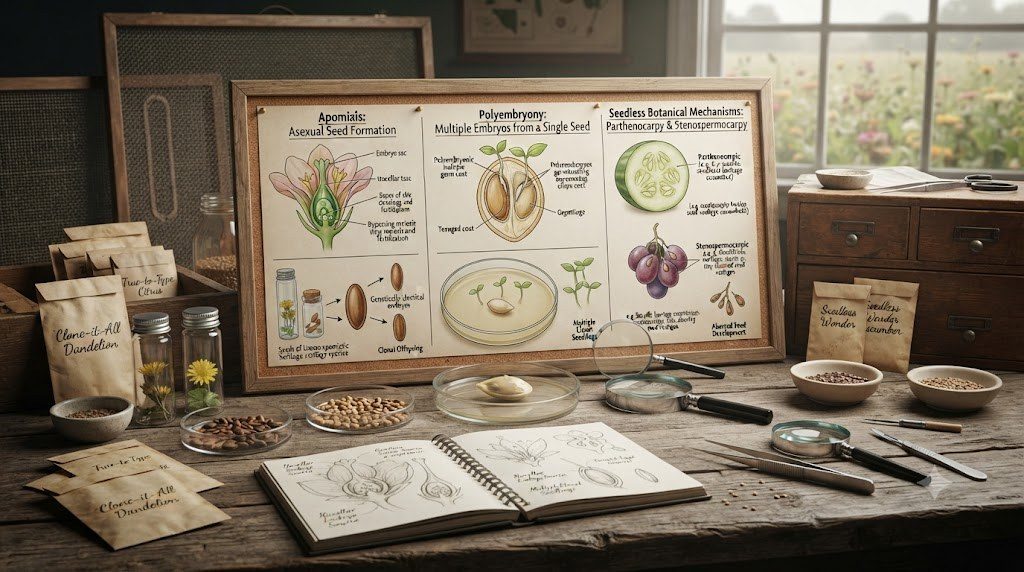
In the vast majority of flowering plants, seed formation is inextricably linked to the drama of sexual reproduction—meiotic recombination of maternal and paternal chromosomes followed by double fertilization. However, nature has evolved breathtaking departures from this paradigm. Foremost among these atypical reproductive pathways are apomixis (asexual seed formation), polyembryony (the development of multiple embryos within a single seed coat), and parthenocarpy coupled with stenospermocarpy (the physiological mechanics underlying seedless fruits).
For plant evolutionary biologists and agricultural biotechnologists, apomixis is regarded as the ‘Holy Grail’ of crop science. If asexual seed reproduction can be introduced into elite commercial hybrid crops, farmers could clone high-yielding F1 hybrids through seeds indefinitely, bypassing expensive annual seed purchases and preserving hybrid vigor across infinite generations. Understanding how somatic ovular cells bypass meiosis, form autonomous unreduced embryos, and coexist alongside zygotic tissues requires an exhaustive investigation into botanical embryology, hormonal signaling, and ploidy dynamics.
1. The Mechanics of Apomixis: Asexual Cloning Through Seed
Apomixis (specifically agamospermy) is the biological process by which a plant produces viable seeds containing an embryo derived entirely from maternal tissue without undergoing meiotic reduction or egg fertilization. The resulting seedling is an exact genetic clone of the mother plant. Apomictic reproduction occurs naturally across more than 40 plant families, including grasses (Poaceae, notably Poa and Paspalum), composite flowers (Asteraceae, such as dandelions Taraxacum and hawkweeds Hieracium), and citrus (Rutaceae).
Natural apomixis operates through three distinct developmental embryological mechanisms:
- Diplospory: The unreduced embryo sac originates directly from the megaspore mother cell (MMC). The MMC either bypasses meiosis entirely (mitotic diplospory) or undergoes an abortive meiosis where sister chromatids fail to separate (meiotic restitution), producing an unreduced (2n) embryo sac. The unfertilized unreduced egg cell then develops autonomously into an embryo (parthenogenesis).
- Apospory: The megaspore mother cell undergoes normal meiosis, but its haploid megaspores subsequently degenerate. Concurrently, one or more somatic cells of the surrounding maternal nucellus differentiate into aposporous initial cells, undergoing mitosis to form an unreduced (2n) embryo sac that gives rise to a clonal embryo.
- Adventitious Embryony (Sporophytic Apomixis): No unreduced embryo sac is formed. Instead, somatic cells within the maternal nucellus or ovule integuments divide directly, developing into embryos that invade the standard embryo sac. This process is widespread in mango (Mangifera indica) and citrus (Citrus species).
2. Pseudogamy vs. Autonomous Apomixis: The Endosperm Dilemma
While an apomictic embryo does not require fertilization to initiate cellular division, the seed as a whole cannot mature without nutritive storage tissue to sustain the developing embryo. This creates a fascinating physiological divergence between autonomous apomixis and pseudogamy:
Autonomous Apomixis: Widespread in the daisy family (Asteraceae), both the unreduced egg cell and the diploid central cell divide autonomously without any pollination. The central cell develops into viable endosperm without the genetic contribution of male pollen. These plants can set 100% fertile, cloned seeds even under complete pollinator exclusion or severe physical isolation.
Pseudogamous Apomixis: Prevalent in grasses (Poaceae) and rosaceous fruit trees (Rubus, Malus). In pseudogamous species, the unreduced egg develops into an embryo without fertilization, but the central cell must be fertilized by a viable pollen grain to stimulate endosperm development. If pollination is prevented, the embryo arrests and the ovule aborts. Pseudogamy maintains an evolutionary requirement for viable pollen production, explaining why many apomictic grasses continue to produce copious floral pollen despite reproducing asexually.
3. Polyembryony: Multiple Embryos in a Single Seed
Polyembryony is the phenomenon wherein two or more viable embryos develop inside the seed coat of a single seed. First documented by Antonie van Leeuwenhoek in 1719 in orange seeds, polyembryony is categorized into true polyembryony (multiple embryos developing within a single embryo sac) and false polyembryony (embryos arising in separate embryo sacs within the same ovule).
In polyembryonic citrus and mango varieties, a single seed planted in nursery soil typically yields between two and eight vigorous seedlings. Microscopic genetic screening reveals a remarkable biological reality: one of these seedlings is usually the zygotic embryo (the sexually recombined offspring resulting from pollination), while the remaining seedlings are nucellar embryos—exact genetic clones of the maternal tree. Because nucellar embryos derive from vigorous, mature maternal tissue, they frequently outgrow the sexually recombined zygotic seedling in nursery pots, allowing fruit growers to propagate true-to-type rootstocks directly from seeds without grafting.
| Botanical Phenomenon | Embryo Genetic Origin | Pollen Requirement | Endosperm Formation | Primary Agronomic Value |
|---|---|---|---|---|
| Diplosporous Apomixis | Clonal (derived from unreduced MMC) | None (Autonomous) | Autonomous central cell division | Perpetuates exact maternal genome |
| Pseudogamous Apospory | Clonal (derived from nucellar cell) | Yes (Pollen triggers endosperm) | Requires sperm fertilization of polar nuclei | Clonal forage grass seed production |
| Nucellar Polyembryony | Mix of 1 Zygotic + Multiple Clonal | Yes (Pollen stimulates ovule) | Triploid endosperm supports all embryos | True-to-type Citrus rootstock propagation |
| Parthenocarpy | Zero embryo (Fruit develops empty) | None or hormonal stimulus | Completely absent; ovules abort | Commercial seedless bananas, cucumbers |
| Stenospermocarpy | Embryo aborts early after fertilization | Yes (Pollination occurs normally) | Endosperm arrests; soft seed traces remain | Commercial seedless table grapes, watermelons |
4. Seedless Botanical Mechanisms: Parthenocarpy vs. Stenospermocarpy
In consumer horticulture, seedlessness is a prized commercial trait in table fruits. Botanically, fruit development without viable seeds occurs through two fundamentally distinct physiological mechanisms:
1. Parthenocarpy (Virgin Fruit Development): The development of the fleshy fruit pericarp without any ovular fertilization occurring. Parthenocarpy can be vegetative (obligate), where fruit develops autonomously in the complete absence of pollination (e.g., commercial Cavendish bananas Musa acuminata, seedless pineapple Ananas comosus, and common fig Ficus carica), or stimulative, where pollination or exogenous auxin/gibberellin sprays are required to trigger fruit expansion, but pollen tubes abort before fertilization occurs.
2. Stenospermocarpy (Embryo Abortion): Fertilization occurs normally, initiating the development of both the embryo and endosperm. However, due to genetic triploidy or specific maternal incompatibility loci, the endosperm rapidly arrests and degenerates within two to four weeks post-anthesis. Deprived of nutrition, the embryo aborts, leaving behind only microscopic, soft, imperceptible seed traces (rudimentary integuments). Stenospermocarpy is the physiological mechanism responsible for premier commercial seedless table grapes (such as ‘Thompson Seedless’) and triploid seedless watermelons.
5. The Holy Grail of Biotechnology: Engineering Synthetic Apomixis
For more than half a century, plant geneticists have attempted to transfer natural apomixis genes from wild grasses into elite cereal crops like rice, wheat, and maize. Engineering synthetic apomixis requires the simultaneous, precise execution of three developmental steps in a sexual plant:
- MiMe (Mitosis instead of Meiosis): Abolishing meiotic reduction by mutating three key meiotic genes (SPO11-1, REC8, and OSD1), forcing the plant to produce clonal diploid unreduced gametes.
- Parthenogenesis Activation: Activating the autonomous division of the unreduced egg cell without fertilization, achieved by expressing the sperm-specific transcription factor BBM1 (BABY BOOM 1) in the female egg cell prior to fertilization.
- Autonomous or Viable Endosperm Formation: Ensuring balanced endosperm development to feed the synthetic clonal embryo.
Breakthrough research published in 2019 and 2022 successfully demonstrated synthetic apomixis in hybrid rice (Oryza sativa), achieving clonal propagation through seeds across multiple generations with over 95% clonal seed set efficiency. This technology promises to democratize hybrid crop farming globally, allowing smallholder farmers in developing nations to save their own high-yielding hybrid seeds without commercial yield penalties.
Frequently Asked Questions (FAQ)
Q: What is apomixis in plant biology?
Apomixis is asexual reproduction through seeds. The plant bypasses meiotic reduction and fertilization, producing viable seeds containing embryos that are genetically identical clones of the maternal parent plant.
Q: Why is apomixis considered the ‘Holy Grail’ of agricultural plant breeding?
If apomixis is engineered into commercial hybrid crops (like maize, wheat, and rice), farmers could save seeds from elite F1 hybrids and replant them indefinitely without losing hybrid vigor (heterosis) or suffering genetic segregation.
Q: What is the difference between autonomous apomixis and pseudogamy?
Autonomous apomixis forms both the embryo and endosperm without any pollination. Pseudogamy produces a clonal embryo without fertilization, but requires male pollen to fertilize the central cell to initiate vital endosperm development.
Q: Why do citrus seeds frequently sprout multiple seedlings from a single seed?
Citrus seeds exhibit nucellar polyembryony. Somatic cells from the maternal nucellus divide directly into multiple clonal embryos alongside the sexually fertilized zygotic embryo, resulting in 2 to 8 seedlings emerging from one seed.
Q: How can citrus growers tell a clonal nucellar seedling from a sexual zygotic seedling?
Nucellar seedlings originate from mature maternal tissue and exhibit vigorous, uniform growth that closely mirrors the parent tree. Zygotic seedlings are often less vigorous, highly variable in leaf morphology, and can be definitively identified via DNA microsatellite marker testing.
Q: What is the difference between parthenocarpy and stenospermocarpy?
In parthenocarpy, fruit develops completely without fertilization (like Cavendish bananas). In stenospermocarpy, fertilization occurs normally, but the embryo aborts shortly after, leaving tiny soft seed traces (like seedless table grapes).
Q: Why are commercial bananas seedless while wild bananas are packed with hard seeds?
Commercial bananas are triploid (3n) hybrids with three sets of chromosomes. During meiosis, homologous chromosomes cannot pair properly, leading to irregular chromosome segregation and complete sterility; fruit fleshes out via obligate parthenocarpy.
Q: Can dandelions reproduce sexually, or are they exclusively apomictic?
Common European dandelions (Taraxacum officinale) are predominantly triploid or tetraploid obligate apomicts that produce seeds asexually via diplospory. However, diploid sexual populations still exist in southern Europe.
Q: What role does the BABY BOOM (BBM1) gene play in synthetic apomixis?
BBM1 is a key transcription factor gene normally carried by male sperm cells that triggers the fertilized egg to start embryonic cleavage. In synthetic apomixis, expressing BBM1 in unfertilized egg cells triggers autonomous embryo development.
Q: What is the primary evolutionary advantage of apomixis in wild plants?
Apomixis allows a well-adapted genotype to rapidly colonize disturbed ecological niches by producing millions of genetically identical seeds without depending on scarce pollinators or compatible mating partners.
Q: Why does polyembryony occur in mangoes?
Certain tropical Southeast Asian mango cultivars (such as ‘Carabao’ and ‘Nam Dok Mai’) possess genetic adventitious embryony. Maternal nucellar tissue buds directly into the seed cavity, producing true-to-type clonal seedlings from seed.
Q: Do gymnosperms exhibit polyembryony?
Yes. In conifers (Pinaceae), simple polyembryony occurs when multiple archegonia are fertilized within a single ovule, or cleavage polyembryony occurs when a single fertilized zygote splits into multiple genetically identical embryos.
Q: Why do commercial seed companies view synthetic apomixis with mixed feelings?
While synthetic apomixis would vastly reduce seed production costs for seed companies, it would also allow farmers to save and replant their own hybrid seeds indefinitely, disrupting annual hybrid seed sales business models.
Q: What is facultative apomixis versus obligate apomixis in natural populations?
Obligate apomicts produce seeds exclusively through asexual means (100% clonal offspring). Facultative apomicts can reproduce both sexually and asexually depending on photoperiod, temperature, and hormonal balance, maintaining a tiny percentage of sexual recombination to generate new adaptive genotypes.
Q: How does ploidy level influence the evolutionary success of apomixis?
Natural apomixis is almost universally associated with polyploidy (triploid, tetraploid, hexaploid). Diploid apomixis is extraordinarily rare in nature because polyploidy buffers the plant against deleterious recessive mutations that inevitably accumulate in the absence of meiotic purging.