From the precise moment an orthodox seed achieves physiological maturity on the mother plant, an inexorable biological countdown begins. Even under optimal post-harvest storage, seeds undergo progressive, irreversible physiological and biochemical decay known universally as seed deterioration or seed aging. Unlike animal senescence, which involves complex neuroendocrine feedback loops, seed aging is a bottom-up biophysical breakdown driven by thermodynamic entropy, macromolecular oxidation, membrane destabilization, and the accumulation of genetic damage.
Understanding the exact biochemical chronology of seed aging is essential for agronomists, seed technologists, and plant breeders. Long before an aged seed lot loses its ability to sprout—the final catastrophic symptom of death—it exhibits subtle, measurable declines in metabolic rate, membrane integrity, seedling vigor, and stress tolerance. Detecting this decline requires rigorous analytical testing, led by the classical Tetrazolium (TZ) biochemical viability assay, electrical conductivity testing, and accelerated aging protocols. This comprehensive treatise explores the molecular pathology of seed deterioration, the chemistry of the tetrazolium reaction, and diagnostic viability assays.
1. The Chronology of Seed Deterioration: The Cascade of Degradation
Seed deterioration does not occur instantaneously; it progresses through a highly predictable, standardized chronological cascade of biochemical and structural failures:
- Phase 1 — Lipid Peroxidation and Membrane Destabilization: In the presence of oxygen, unsaturated fatty acids (linoleic and linolenic acids) within membrane phospholipids undergo non-enzymatic free-radical autoxidation. This produces toxic lipid hydroperoxides, conjugated dienes, and volatile hexanal hydrocarbons. Cell membranes lose their liquid-crystalline organization, developing micro-fissures that lead to rampant solute leakage upon rehydration.
- Phase 2 — Protein Inactivation & Loss of Enzymatic Function: Free radicals and reactive aldehydes attack catalytic proteins, causing protein carbonylation and cross-linking. Crucial respiratory enzymes—including malate dehydrogenase, glucose-6-phosphate dehydrogenase, and catalase—suffer irreversible conformational unfolding, crippling cellular energy generation.
- Phase 3 — DNA Fragmentation & Epigenetic Lesions: Chromatin structures degrade. Endonucleases and oxidative radicals induce single- and double-strand DNA breaks, thymine dimer formations, and chromosome aberrations. While young seeds deploy sophisticated DNA repair ligases upon imbibition, aged seeds exhaust their repair capacity before replication can begin.
- Phase 4 — Decline in Germination Speed and Seedling Vigor: The seed still germinates, but the process is sluggish. Emerged seedlings display stunted radicles, spiral hypocotyls, patchy chlorophyll synthesis, and extreme vulnerability to soil-borne damping-off fungi (Pythium and Rhizoctonia).
- Phase 5 — Complete Loss of Germination (Seed Death): The embryonic axis suffers necrotic death. Cell membranes completely disintegrate, the embryo fails to respire upon hydration, and the seed succumbs to saprophytic bacterial decay.
2. The Chemistry of the Tetrazolium (TZ) Assay
First developed by German scientist Georg Lakon in 1942, the Tetrazolium (TZ) Test remains the globally accepted gold standard for rapid, non-destructive biochemical determination of seed viability without waiting days or weeks for physical germination.
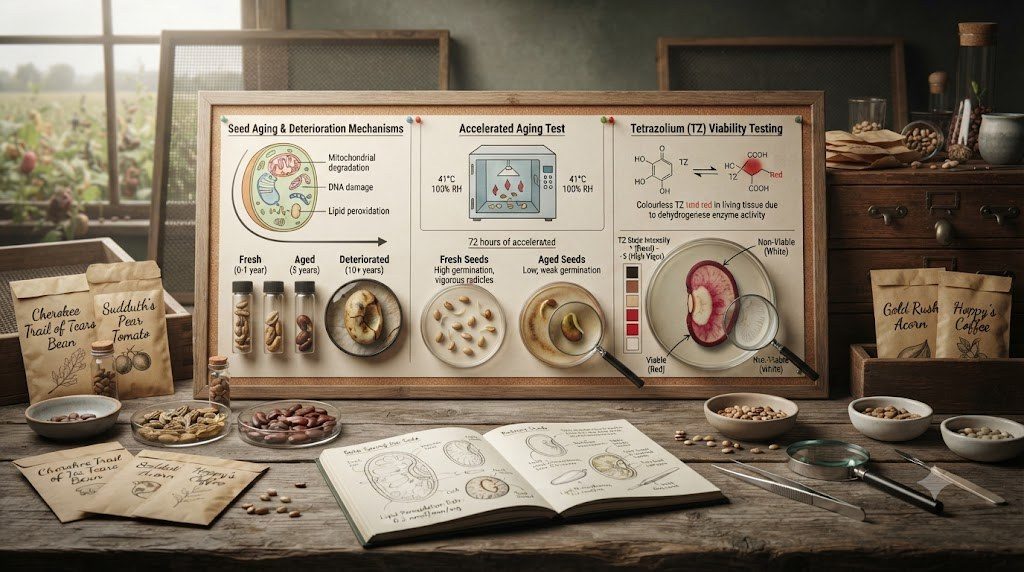
The biochemical mechanism of the TZ assay relies on the activity of active mitochondrial dehydrogenase enzymes (specifically malate dehydrogenase and succinate dehydrogenase). In living, respiring embryonic cells, these dehydrogenases transfer hydrogen ions ($H^+$) and electrons from Krebs cycle intermediates to the applied colorless water-soluble salt: 2,3,5-triphenyl tetrazolium chloride.
Upon chemical reduction, the tetrazolium molecule undergoes irreversible ring-opening and hydrogenation, precipitating into an intensely colored, stable, water-insoluble red pigment: triphenyl formazan:
2,3,5-Triphenyl Tetrazolium Chloride (Colorless) + 2H^+ + 2e^- → Triphenyl Formazan (Carmine Red) + HCl
Because formazan is insoluble in water, it precipitates directly within the living cells where reduction occurred, permanently staining functional, metabolically active tissues bright carmine red. Dead tissues lacking active respiratory dehydrogenases remain completely unstained, appearing dull, chalky white or yellowish. Weak, deteriorating tissues exhibit mottled, pale pink, or patchy staining patterns.
3. Electrical Conductivity (EC) Testing: Solute Leakage as a Vigor Marker
While the TZ assay evaluates enzymatic viability, the Electrical Conductivity (EC) Test evaluates the physical integrity of cell membranes. When a dry seed is placed into water, it undergoes rapid physical imbibition. In young, highly vigorous seeds, cell membranes rehydrate and quickly reorganize from the leaky hexagonal-II phase into a continuous liquid-crystalline bilayer within minutes, sealing cellular solutes inside.
In deteriorated, aged seeds, oxidized membranes are rigid and ruptured. During early imbibition, internal electrolytes—primarily potassium ions (K+), magnesium (Mg2+), organic phosphate ions, soluble sugars, and amino acids—leak uncontrollably out of the embryo into the surrounding soak water. By inserting an electrical conductivity probe into the soak water after 24 hours, seed analysts measure electrical conductance in microSiemens per centimeter per gram (microS/cm/g). Higher electrical conductivity correlates directly with severe membrane degradation, reduced field emergence, and low seed vigor.
| Deterioration Stage | Membrane Status | Dehydrogenase Activity (TZ) | Electrolyte Leakage (EC) | Field Emergence Capacity |
|---|---|---|---|---|
| Pristine (High Vigor) | Intact liquid-crystalline bilayer | Uniform bright carmine red | Ultra-low (< 18 microS/cm/g) | Rapid, uniform emergence under stress |
| Early Senescence | Minor lipid peroxidation | Uniform red with pale tips | Low to moderate (18 – 28 microS/cm/g) | Normal emergence under ideal conditions |
| Advanced Deterioration | Extensive membrane micro-fissuring | Mottled pink; necrotic white spots | High (30 – 45 microS/cm/g) | Sluggish emergence; high damping-off losses |
| Terminal Decay | Completely lysed membranes | Irregular faint staining; soft tissue | Very high (> 50 microS/cm/g) | Abnormal seedlings; stunted radicles |
| Dead Seed Lot | Total membrane collapse | 100% Chalky white; zero reduction | Extreme (> 65 microS/cm/g) | 0% emergence; seed rots in soil |
4. Accelerated Aging (AA) and Controlled Deterioration (CD) Tests
Standard germination tests performed under pristine laboratory conditions (warm, moist paper towels in optimal growth chambers) frequently fail to predict actual field performance. A seed lot with subtle membrane decay may achieve 95% germination in a laboratory, yet collapse to 45% emergence when planted in cold, waterlogged agricultural soil.
To expose hidden physiological decay, seed labs employ Accelerated Aging (AA) and Controlled Deterioration (CD) stress tests:
- The Accelerated Aging (AA) Test: Primarily utilized for large-seeded field crops (soybeans, corn, beans). Seeds are suspended over water in sealed aging boxes and subjected to extreme abiotic stress: 41°C to 43°C and 100% relative humidity for 48 to 72 hours. This severe heat-humidity regime accelerates biochemical deterioration millions of times faster than ambient storage. The seeds are subsequently removed and germinated under standard conditions; lots that maintain high germination (> 80%) after AA testing possess superior field vigor and warehouse longevity.
- The Controlled Deterioration (CD) Test: Developed specifically for small-seeded horticultural crops (brassicas, carrots, onions, tomatoes). Seed moisture is precisely raised to a constant level (typically 20% to 24%), sealed in vapor-proof foil pouches, and incubated in a constant-temperature water bath at 45°C for 24 hours. CD testing provides unparalleled resolution in ranking commercial vegetable seed lots for market storage life.
5. Epigenetic Scars and Chromosomal Aberrations in Aged Germplasm
When an aged seed lot is successfully revived through specialized priming or rescue protocols, its progeny may still carry the biological scars of deterioration. Decades of storage under suboptimal conditions induce severe epigenetic changes and cytogenetic aberrations:
Cytological examination of root-tip meristems in aged seedlings reveals high frequencies of chromatid breaks, anaphase bridges, micronuclei, and translocation mutations. Concurrently, DNA methyltransferase enzymes suffer functional decline, leading to aberrant genome-wide DNA hypomethylation. These genetic and epigenetic lesions manifest phenotypically as somatic sectoring, delayed flowering transitions, reduced pollen fertility, and diminished harvest yields—underscoring why gene banks must regenerate seed accessions before viability falls below the critical 75% threshold.
Frequently Asked Questions (FAQ)
Q: What is the difference between seed viability and seed vigor?
Viability is simply whether a seed is alive and capable of germinating under ideal conditions. Vigor is the capacity of that seed to germinate rapidly, uniformly, and establish healthy seedlings under harsh, stressful field conditions.
Q: How does the Tetrazolium (TZ) test determine if a seed is alive in just a few hours?
Colorless tetrazolium salt is reduced by active mitochondrial dehydrogenase enzymes in living, respiring tissue, producing an insoluble bright carmine-red dye called formazan. Dead tissue lacks active enzymes and remains chalky white.
Q: Why must seeds be soaked in water before performing a tetrazolium test?
Soaking softens the tough seed coat and hydrates internal embryonic tissues, activating respiratory dehydrogenase enzymes so they can chemically react with the tetrazolium solution.
Q: What causes aged seeds to leak solutes into soak water during conductivity testing?
Aged seeds suffer lipid peroxidation that ruptures cell membranes. Upon rehydration, compromised membranes cannot seal, allowing ions (K+), sugars, and amino acids to leak out into the water, raising electrical conductivity.
Q: What is the Accelerated Aging (AA) test used for in commercial seed labs?
The AA test exposes seeds to extreme stress (41°C-43°C and 100% RH for 48-72 hours) to simulate years of warehouse storage in days. It separates high-vigor seed lots from weak lots that would spoil quickly in transport.
Q: Why do onion and parsnip seeds lose viability much faster than wheat or corn?
Onion and parsnip seeds contain high levels of unsaturated fatty acids and thin, permeable seed coats that make them acutely vulnerable to rapid lipid autoxidation and membrane collapse within 1 to 2 years.
Q: Can a seed that stains completely red in a TZ test still fail to germinate?
Yes. If the seed has suffered severe chromosomal damage, heat injury that paralyzed DNA replication, or extreme dormancy blocks, it may still respire and stain red while being physically unable to complete seedling development.
Q: What are the primary free radicals responsible for seed deterioration?
The primary culprits are Reactive Oxygen Species (ROS): superoxide radicals (O2•-), hydrogen peroxide (H2O2), and highly reactive hydroxyl radicals (•OH), which attack polyunsaturated fatty acids and DNA.
Q: Why do aged seeds produce abnormal seedlings with curled roots and stunted shoots?
Because meristematic cells in the radicle and shoot apex suffer localized cell death and chromosomal breaks during aging, preventing normal directional cell elongation and division.
Q: What is Controlled Deterioration (CD) testing and how does it differ from AA testing?
CD testing is used for small vegetable seeds, where seed moisture is raised to an exact constant percentage (e.g., 20%) before hermetic incubation at 45°C, providing higher uniformity than open-air AA boxes.
Q: How does lipid autoxidation occur in seeds stored in bone-dry, dark containers?
Lipid autoxidation is a non-enzymatic free-radical chain reaction driven by atmospheric oxygen reacting directly with unsaturated double bonds in fatty acids, requiring zero moisture or light to progress slowly over time.
Q: What is an anaphase bridge in aged seed cytology?
An anaphase bridge is a structural chromosome aberration where broken chromosome arms fuse incorrectly during mitosis. During anaphase, the fused chromosome is pulled toward both poles, forming a stretched bridge that breaks and disrupts cell division.
Q: Why is seed lot vigor testing critical for precision mechanized agriculture?
Modern precision planters drop individual seeds at exact spacings. If seed vigor is low, delayed emergence leads to uneven plant canopies, poor weed competition, and significant commercial harvest yield losses.
Q: Can seed priming reverse the genetic damage accumulated during seed aging?
Priming can activate endogenous enzymatic DNA repair mechanisms and restore membrane integrity in moderately aged seeds, but it cannot resurrect dead cells or repair massive chromosome breakage in severely deteriorated seed lots.