In the evolutionary arms race between angiosperms and their environments, the development of a hard, impermeable seed coat represents an extraordinary adaptation for long-term survival in hostile soils. Known in botanical science as physical dormancy (PY) or ‘hardseededness,’ this condition is characterized by a maternal testa so heavily sclerified, suberized, and impregnated with hydrophobic waxes that water molecules and oxygen cannot penetrate the interior. Without external intervention, hard seeds can lie dormant in the soil seed bank for decades—or even centuries—waiting for natural abrasions, microbial decay, digestive passage through animal guts, or wildfire heat to crack their outer defenses.
For modern horticulturists, agroforesters, and commercial growers propagating legumes (Fabaceae), mallows (Malvaceae), cannas (Cannaceae), and hard-seeded woody species, waiting years for spontaneous dormancy release is economically impossible. Overcoming physical dormancy requires scarification—the deliberate mechanical, chemical, or thermal breaching of the impermeable seed coat without inflicting lethal trauma upon the fragile underlying embryonic axis. Mastering scarification protocols demands precise calibration of abrasive depth, chemical concentration, thermal dwell time, and microbiological sanitation. This comprehensive treatise explores the micro-anatomical barriers of physical dormancy, mechanical abrasion engineering, concentrated acid protocols, hot water thermodynamics, and embryonic safety margins.
1. The Anatomical Barrier: Macrosclereid Layers and the Water Gap
To successfully scarify a seed without killing the embryo, a propagator must understand the cellular micro-anatomy of the testa. In hard-seeded plant families, the impermeable barrier is not the entire seed coat, but a specialized outermost cellular stratum:
- The Cuticle and Waxy Suberin Layer: An external hydrophobic lipid film that repels ambient liquid water and shields the seed against early fungal digestion.
- Macrosclereids (Malpighian Palisade Cells): Columnar sclerenchyma cells oriented perpendicular to the seed surface, packed together with zero intercellular spaces. Their secondary cell walls are heavily impregnated with cellulose, hemicellulose, lignin, and quinone-tanned polyphenolic tannins. In species like black locust (Robinia pseudoacacia) and Kentucky coffeetree (Gymnocladus dioicus), these cells form an impenetrable fortress.
- The Linea Lucida (Light Line): A continuous refractive optical boundary running across the upper third of the macrosclereid layer, characterized by extreme physical density and localized suberization that halts water molecule migration.
- The Strophiole / Lens (The Morphological Water Gap): In legumes, a structurally specialized cleft located near the hilum. In nature, natural fire heat or diurnal thermal cycling causes the strophiole to fracture or ‘pop open,’ acting as an environmentally triggered one-way hydraulic valve.
2. Mechanical Scarification: Sanding, Chipping, and Tumbling Engineering
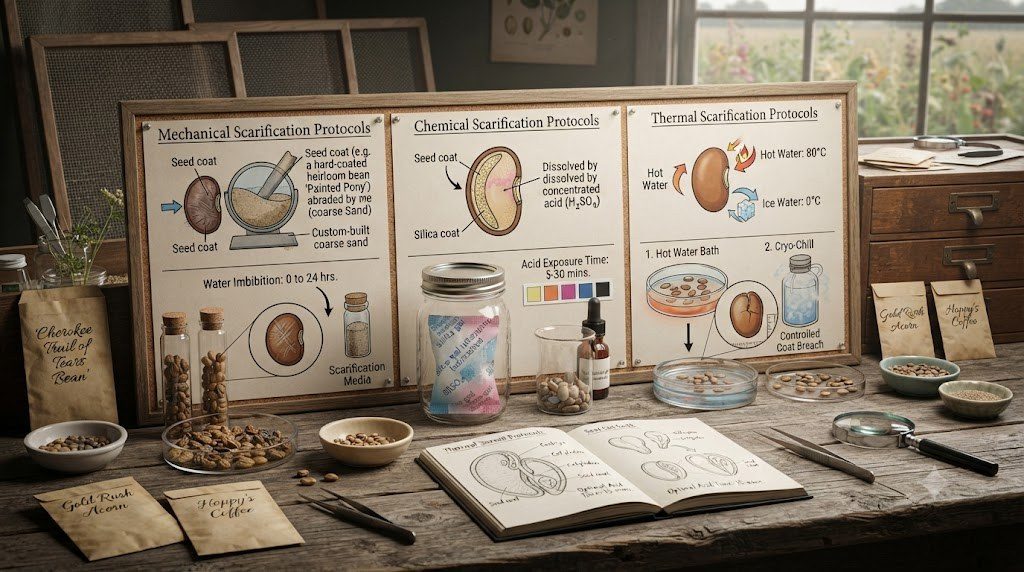
Mechanical scarification physical abrades, cracks, or files through the sclerified macrosclereid layer, opening a localized breach through which water can enter. The primary challenge is anatomical targeting: the breach must be made through the cotyledonary shoulder of the seed coat, strictly avoiding the hilum, micropyle, and underlying radicle tip. Cracking the seed coat directly over the embryonic axis results in instant mechanical decapitation of the radicle upon hydration.
Methodologies scale based on operational volume:
- Manual Precision Scarification (Low Volume / Rare Seeds): Using handheld needle files, abrasive emery boards, sandpaper (120 to 180 grit), or micro-wire cutters. The operator files the seed coat opposite the hilum until a subtle color change occurs—signaling that the dark outer testa has been breached and the pale cotyledon tissue is exposed. The seed is immediately soaked in water; successful scarification is confirmed when the seed swells to twice its original volume within 12 to 24 hours.
- Rotary Abrasive Drum Tumbling (Commercial Batch Processing): Seeds are placed inside a rotary rock tumbler or seed scarifier lined with coarse silicon carbide abrasive paper (80 to 120 grit) and tumbled for 15 to 60 minutes. Frictional contact wears down the waxy cuticle uniformly across thousands of seeds simultaneously. Operators must run destructive pilot sub-samples to calibrate tumbling duration, ensuring the embryo is not crushed by excessive centrifugal impact.
3. Chemical Acid Scarification: Concentrated Sulfuric Acid (H2SO4) Protocols
For large-scale agricultural and forestry applications—such as preparing thousands of pounds of hard-seeded alfalfa (Medicago sativa), clover (Trifolium), or black locust tree seeds—mechanical abrasion is labor-prohibitive. The commercial gold standard is chemical acid scarification utilizing commercial-grade concentrated sulfuric acid (93% to 98% H2SO4, technical grade).
Sulfuric acid acts as an aggressive dehydrating and oxidizing agent. When immersed in concentrated acid, the outer waxy cuticle and lignified macrosclereid cell walls are rapidly carbonized, dissolved, and digested into soluble sulfonated sugars. Because the treatment relies on extreme chemical reactivity, safety and timing protocols must be executed with laboratory rigor:
- Bone-Dry Seed Prerequisite: The seed lot must be thoroughly dry before treatment. If residual moisture is present on the seed coat, adding concentrated sulfuric acid triggers a violent exothermic reaction (H2SO4 + H2O -> Boiling Steam + Extreme Heat), incinerating the embryo within seconds.
- Immersion Dwell Time Calibration: Dwell times vary dramatically by species—from 5 to 10 minutes for thin-coated clovers up to 60 to 120 minutes for thick-coated woody legumes (like Gleditsia triacanthos). During immersion, the mixture must be gently stirred with a glass or acid-resistant PTFE rod to ensure uniform contact.
- Quenching and Neutralization: At the precise termination of the dwell time, the acid must be poured off through an acid-resistant wire mesh, and the seeds dumped into a voluminous bath of cold water accompanied by rapid, continuous agitation. Rinsing must continue under running water for 5 to 10 minutes to wash away all acid residues. Many facilities incorporate a final neutralizing dip in a 1% sodium bicarbonate ($NaHCO_3$) solution to buffer surface pH back to neutral.
| Botanical Species | Recommended Scarification Method | Optimal Protocol / Dwell Time | Post-Treatment Swelling (24h) | Typical Germination % |
|---|---|---|---|---|
| Lupine (Lupinus polyphyllus) | Manual Sanding / Emery Board | Sand shoulder opposite hilum | 100% swollen in 12 hours | 88% – 95% |
| Morning Glory (Ipomoea tricolor) | Warm Water Soak or Nicking | Single shallow razor nick | Doubles in volume in 8 hours | 90% – 96% |
| Black Locust (Robinia pseudoacacia) | Concentrated H2SO4 (98%) | 60 minutes immersion; cold rinse | Uniform swelling across lot | 85% – 92% |
| Redbud (Cercis canadensis) | Acid -> Cold Stratification | H2SO4 30 min -> 60d cold strat | Must break PY first, then PD | 80% – 88% |
| Canna Lily (Canna indica) | Hacksaw / Dremel Rotary Tool | Cut through dark coat to white core | Swells within 24 hours | 92% – 98% |
| Alfalfa / Clover (Commercial) | Rotary Sandpaper Tumbler | 15 – 20 minutes batch tumble | Field emergence synchronized | 85% – 90% |
4. Thermal Scarification: Hot Water Immersion Thermodynamics
For home horticulturists and organic growers who avoid hazardous concentrated acids, thermal scarification (hot water shock) provides a highly accessible, biologically effective alternative for medium-hard seeds. Thermal scarification does not dissolve the seed coat; instead, it exploits differential thermal expansion coefficients between structural layers of the testa.
The standard scientific protocol operates as follows:
Water is brought to a rapid rolling boil (100°C) and immediately removed from the heat source. The dry seeds are dropped into the hot water at an initial volume ratio of 1 part seeds to 5 to 10 parts hot water. The sudden thermal shock causes the brittle, outer macrosclereid layer to expand rapidly while the cooler, dense inner layers resist expansion. This thermal stress fractures the strophiole and creates microscopic fissures along the linea lucida. As the water cools naturally to room temperature over 12 to 24 hours, water molecules pass through these thermal micro-fissures, hydrating the internal cotyledons.
The Lethal Overheating Risk: Seeds must *never* be boiled continuously on an active burner. Sustained exposure to 100°C water for more than 30 to 60 seconds drives thermal energy through the seed coat into the embryonic axis, causing irreversible denaturation of cellular enzymes and killing the seed. The heat source must always be extinguished before introducing seeds.
5. Biological Scarification: Microbial Digestion and In-Vivo Passaging
In natural ecological biomes, hard-seeded plants do not rely on sulfuric acid bottles or sanders; they rely on biological scarification mediated by soil microorganisms or frugivorous animal digestive tracts:
1. Soil Microflora Decomposition: In wild soil seed banks, hard seeds lie embedded in decomposing leaf litter rich in cellulolytic and lignolytic fungi (such as Trichoderma, Chaetomium, and white-rot basidiomycetes) alongside bacteria (Bacillus and Streptomyces). These microbes slowly secrete cellulase, xylanase, and laccase enzymes, gradually degrading the waxy cuticle and softening the macrosclereids over several months until moisture finally penetrates.
2. In-Vivo Digestive Passaging (Endozoochory): Many fruit-bearing and pod-bearing plants (such as mesquite Prosopis, acacia, and wild hawthorns) produce nutrient-dense pods designed to be consumed by herbivores (cattle, deer, elephants, tortoises). As seeds travel through the animal’s digestive tract, they encounter mechanical mastication by molars, strong gastric hydrochloric acid (pH 1.5 to 2.5), and proteolytic digestive enzymes. This digestive gauntlet dissolves the seed coat waxes without harming the resilient embryo. The seed is subsequently excreted in a nutrient-dense dung pile that provides optimal moisture and organic fertilization for immediate germination.
Frequently Asked Questions (FAQ)
Q: What is physical seed dormancy?
Physical dormancy is an innate condition where a hard, waterproof seed coat prevents water and oxygen from entering the seed, keeping the living embryo dormant until the outer shell is breached.
Q: What is the difference between scarification and stratification?
Scarification is the physical, chemical, or thermal breaching of a hard, impermeable seed coat. Stratification is moist chilling (or warming) to break internal physiological dormancy inside the embryo.
Q: Where on the seed should you make a mechanical cut during scarification?
Always make the cut along the curved broad shoulder of the seed, strictly away from the hilum (eye) and micropyle, where the fragile embryonic radicle is located.
Q: Why must seeds be completely dry before acid scarification?
If water is present on the seeds when concentrated sulfuric acid is added, the violent exothermic reaction boils the water instantly, producing extreme heat that destroys the embryo.
Q: How do you know if a seed has been successfully scarified?
Soak the scarified seed in room-temperature water for 12 to 24 hours. If it absorbs water and swells to 1.5 to 2 times its original size, scarification was successful.
Q: Can you boil seeds on a stove burner to scarify them?
No. Boiling seeds continuously cooks the embryo and denatures essential proteins, killing the seed. You must boil water, remove the pot from heat, and then drop the seeds in to cool naturally.
Q: What safety gear is mandatory when using sulfuric acid for seed scarification?
Operators must wear chemical-resistant neoprene gloves, full-face splash shields, laboratory aprons, and work inside a certified fume hood with nearby emergency eyewash stations.
Q: Why do legume seeds have such hard seed coats in nature?
It is an evolutionary survival strategy allowing seeds to survive drought, fire, and animal digestion, building a persistent soil seed bank that germinates over multiple years.
Q: What is the role of the strophiole or lens in legume seed coats?
The strophiole is a structurally weakened zone near the hilum that acts as a natural pressure valve, fracturing under environmental heat or abrasion to allow water into the seed.
Q: Can sandpaper in a rock tumbler be used to scarify seeds in bulk?
Yes. A rotary tumbler lined with 80-120 grit silicon carbide sandpaper can abrade thousands of hard seeds simultaneously in 15 to 45 minutes without using dangerous chemicals.
Q: What is endozoochory in seed dispersal?
Endozoochory is seed dispersal via ingestion by animals. Stomach acids and digestive enzymes scarify hard seed coats as they pass through the gut, preparing seeds to sprout in manure.
Q: What should you do if an acid-scarified seed lot doesn’t swell after soaking?
It indicates the acid dwell time was too short to breach the thick macrosclereid layer. The seeds must be dried thoroughly and subjected to a slightly longer acid immersion.
Q: Can hot water scarification be used on thin-coated vegetable seeds like lettuce?
No. Hot water shock is intended strictly for thick, hard-seeded legumes and woody species. Thin-coated seeds will be cooked and killed instantly by hot water.
Q: Why is a sodium bicarbonate dip used after acid scarification?
A 1% sodium bicarbonate (baking soda) wash neutralizes residual sulfuric acid on the seed coat, preventing acid burns from damaging emerging seedlings.