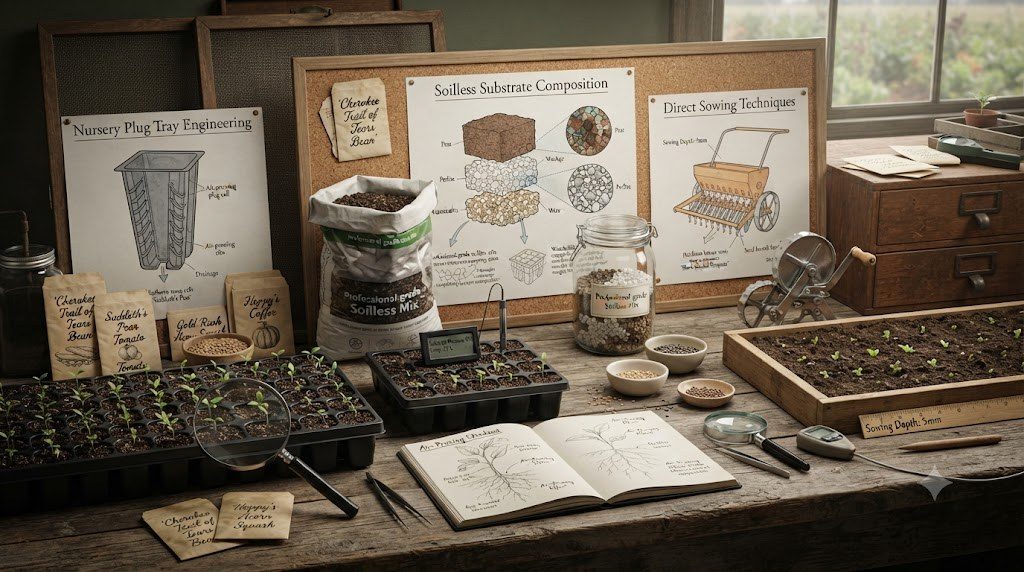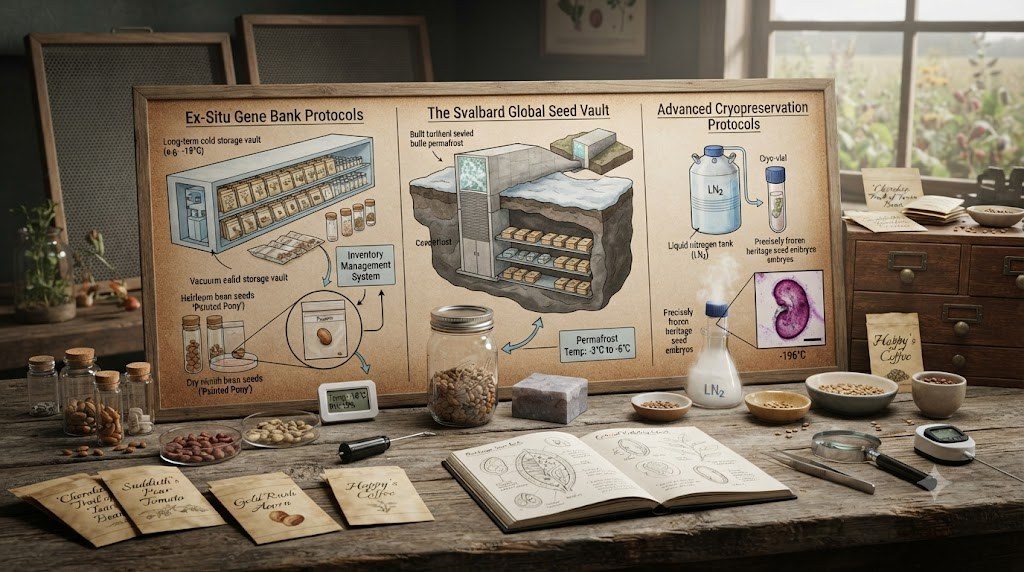
In an era marked by accelerating anthropogenic climate disruption, widespread habitat fragmentation, and rapid agricultural genetic erosion, ex-situ seed banking represents human civilization’s ultimate biological insurance policy. Deep within fortified subterranean vaults—most famously the Svalbard Global Seed Vault carved into Arctic permafrost, the Millennium Seed Bank at Kew, and the CGIAR international gene banks—billions of orthodox seeds are preserved in a state of suspended metabolic animation. These repositories do not merely warehouse dry grain; they curate the irreplaceable evolutionary legacy of agricultural landraces, crop wild relatives (CWRs), and endangered botanical flora.
Operating an international standards-compliant germplasm repository requires extraordinary technical rigor governed by protocols codified by the Food and Agriculture Organization (FAO) and the International Seed Testing Association (ISTA). Every stage—from taxonomic field voucher collection and non-destructive X-ray radiography screening to precision desiccation, hermetic barrier sealing at -18°C, and ultra-low temperature liquid nitrogen cryopreservation (-196°C)—demands absolute thermodynamic control. This comprehensive treatise explores the engineering, biological standards, regeneration monitoring, and cryobiological protocols that define modern seed gene bank conservation.
1. International Gene Bank Standards: FAO and ISTA Operational Directives
Global germplasm conservation operates under the rigorous normative framework established by the FAO Genebank Standards for Plant Genetic Resources for Food and Agriculture. These international standards partition seed banking into two distinct functional tiers:
- Active Collections (Medium-Term Storage): Maintained for immediate distribution to plant breeders, research scientists, and farmer-led participatory breeding trials. Seeds are conditioned to 5%–8% moisture content and held at temperatures between 0°C and 5°C (or up to 10°C for short cycles). Under these conditions, orthodox seeds remain highly viable for 10 to 30 years while permitting routine withdrawal and distribution without thermal shock.
- Base Collections (Long-Term Conservation): Functioning strictly as permanent genetic insurance vaults. Seeds are desiccated to equilibrium with 15% relative humidity at 15°C (achieving 3% to 6% moisture content depending on lipid fractions), hermetically sealed inside heavy-duty multi-layer laminated aluminum foil pouches (or vacuum-sealed glass ampoules), and permanently held at -18°C ± 2°C with relative humidity maintained below 15%. Under base collection conditions, viability is calculated to endure from 50 to more than 500 years.
- Safety Duplication: FAO standards mandate that every unique accession held in a base collection must have a secondary safety duplicate stored in a geographically distinct nation, and ideally a tertiary black-box deposit deposited in the Svalbard Global Seed Vault.
2. The Architecture of Svalbard: The Ultimate Arctic Failsafe
Located on the remote Norwegian archipelago of Spitsbergen, 1,300 kilometers within the Arctic Circle, the Svalbard Global Seed Vault (colloquially known as the 'Doomsday Vault') represents the apex of passive failsafe engineering. Excavated 120 meters deep into the solid sandstone interior of Platåberget mountain, the facility was designed to survive catastrophic global cataclysms, including nuclear detonations, sea-level rises, and prolonged global power grid failures.
Svalbard operates as a pure 'black box' repository: the Nordic Genetic Resource Center (NordGen) manages physical operations, but depositors retain sovereign intellectual and physical property rights over their deposits. Seeds arrive pre-dried and vacuum-sealed in five-ply foil pouches inside standard Nordic storage boxes (holding approx. 500 accessions per box). The mountain permafrost provides natural ambient sub-surface temperatures of -3°C to -4°C. Supplemental industrial cooling compressors chill the storage caverns down to the official FAO base standard of -18°C.
3. Cryopreservation: Storing Genetic Material at -196°C in Liquid Nitrogen
While orthodox seeds thrive in conventional -18°C mechanical freezers, two biological classes cannot be conserved in standard seed vaults: recalcitrant seeds (which die upon drying) and intermediate seeds (which suffer chilling injury at -20°C). Preserving these species mandates cryopreservation in liquid nitrogen (-196°C) or liquid nitrogen vapor phase (-150°C to -180°C).
At -196°C, all chemical kinetics cease; thermal kinetic energy is insufficient to drive enzymatic reactions or radical-induced lipid degradation. Biological longevity in liquid nitrogen is theoretically infinite (projected past 10,000 years), limited only by background ionizing cosmic radiation.
Cryobiological protocols bypass lethal intracellular ice crystallization using advanced vitrification techniques:
- Embryonic Axis Excision: Because whole seeds are too bulky to vitrify uniformly, microscopically excised zygotic embryos or shoot apical meristems (0.5 to 1.5 mm) are isolated under sterile dissecting microscopes.
- Chemical Pre-Conditioning: Tissues are treated with high-sucrose loading solutions (0.4 M to 0.75 M) to initiate osmotic cellular dehydrations and stimulate endogenous osmolyte synthesis.
- Plant Vitrification Solutions (PVS2 / PVS3): Tissues are exposed for precisely timed intervals (typically 20 to 60 minutes at 0°C) to concentrated cryoprotectant mixtures. PVS2 consists of 30% glycerol, 15% ethylene glycol, and 15% dimethyl sulfoxide (DMSO) in 0.4 M sucrose. These solutes permeate cells, binding water molecules so tightly that water cannot organize into crystalline ice lattices during cooling.
- Ultra-Rapid Plunging: Excised tissues placed on thin aluminum foil strips are plunged directly into liquid nitrogen, achieving cooling velocities exceeding 1,000°C per minute. Cellular water transitions directly into a glassy, amorphous vitrified solid.
| Conservation Category | Storage Medium & Temperature | Target Moisture Content | Expected Longevity | Applicable Plant Taxa |
|---|---|---|---|---|
| Active Collection | Mechanical cold room (+4°C) | 6% - 8% Fresh Weight | 15 - 30 years | Working collections; all orthodox crops |
| Base Collection | Mechanical freezer (-18°C) | 3% - 6% Fresh Weight | 100 - 500+ years | Permanent genetic insurance; orthodox crops |
| Arctic Failsafe (Svalbard) | Permafrost vault (-18°C) | 3% - 5% Fresh Weight | Hundreds to thousands of years | Global safety duplicates of orthodox seeds |
| Liquid Nitrogen Cryo | Liquid nitrogen (-196°C) | Excised axes treated with PVS2 | Theoretically infinite (> 5,000 yrs) | Recalcitrant crops (cocoa, coffee, avocado, rubber) |
| In Vitro Tissue Vault | Slow-growth culture (15°C) | Hydrated agar media + mannitol | 1 - 3 years between transfers | Clonally propagated crops (potato, cassava, banana) |
4. Quality Control Screening: X-Ray Radiography and Tetrachloroethylene Assays
Before any seed accession is sealed into permanent vault storage, it must undergo non-destructive quality screening. Depositing empty, insect-damaged, or mechanically cracked seeds wastes valuable vault space and skews future viability tests:
Digital Soft X-Ray Radiography: Modern gene banks utilize digital X-ray inspection (operating at 15 to 30 kV). X-rays penetrate seed coats, generating real-time high-resolution internal radiographic images. In seconds, technicians assess: (1) internal embryonic morphology, (2) degree of endosperm filling (identifying empty, aborted, or shriveled seeds), (3) hidden internal infestations (larvae of Bruchidae weevils or chalcid wasps consuming cotyledons from within), and (4) micro-fissuring of the cotyledonary axis caused by rough mechanical harvesting.
Density Flotation Screening: Utilizing specialized fluid density gradients or heavy non-polar solvents (such as historically calibrated organic fractions) to separate hollow or insect-damaged seeds from fully filled, viable seeds without initiating water imbibition.
5. Viability Monitoring and Regeneration Protocols
Seed banking is not a static archival science; it is a dynamic cycle of monitoring and biological renewal. Over decades of sub-zero storage, seeds accumulate subtle, inevitable background mutations, DNA single-strand breaks, and membrane micro-lesions. Gene banks institute structured monitoring schedules to track this slow decline:
- Baseline Viability Germination Test: Performed immediately prior to packaging. A minimum of 200 seeds (or 100 for rare accessions) are germinated under standardized ISTA conditions. Initial accession viability must exceed 85% (or 90% for elite cereals).
- Scheduled Periodic Auditing: Sub-samples are withdrawn from active collections every 5 to 10 years (and every 10 to 20 years from base collections) and subjected to standard germination trials.
- The Critical Regeneration Trigger: If an accession's germination viability drops by more than 15% from its baseline, or falls below 75%, an immediate regeneration cycle is mandated. Seeds are removed from storage, germinated in controlled growth chambers, and grown out to maturity in isolation plots to harvest a fresh, vigorous generation of genetically pure seeds.
Frequently Asked Questions (FAQ)
Q: What is the primary difference between an active collection and a base collection?
Active collections are held at +4°C for immediate distribution, research, and breeding trials with a lifespan of 15-30 years. Base collections are held permanently at -18°C as long-term genetic insurance with lifespans exceeding hundreds of years.
Q: Where is the Svalbard Global Seed Vault located and why was that site chosen?
It is located on Spitsbergen island in Norway's Arctic Svalbard archipelago. The site was chosen for its geological stability, lack of tectonic activity, cold dry climate, isolation, and permafrost that keeps seeds naturally frozen.
Q: How long can seeds survive at -18°C in a base collection?
Depending on the species, orthodox seeds (such as barley, peas, and wheat) are projected to retain high germination viability for 200 to more than 1,000 years when moisture is correctly held between 3% and 6%.
Q: Why can't recalcitrant seeds like cocoa or avocado be stored in Svalbard?
Recalcitrant seeds cannot survive dehydration below 25-35% moisture content. Freezing hydrated seeds causes water to expand into sharp ice crystals that shred cell membranes and kill the embryo instantly.
Q: What is PVS2 and why is it used in cryopreservation?
PVS2 (Plant Vitrification Solution 2) is a mixture of 30% glycerol, 15% ethylene glycol, and 15% DMSO in sucrose. It replaces cellular water, allowing excised plant embryos to vitrify into a protective glass state at -196°C without ice crystal formation.
Q: What is a 'black box' arrangement in international seed banking?
Under a black box deposit (like at Svalbard), the depositor retains 100% legal ownership and control over the seeds. The vault facility merely provides secure storage; no one else can open, test, or distribute the deposited seeds.
Q: How does digital X-ray radiography help seed bank technicians?
Soft X-rays allow non-destructive visualization of internal seed anatomy, revealing whether the seed is fully filled, contains an underdeveloped embryo, has internal cracks, or harbors hidden insect larvae.
Q: When is a seed bank required to regenerate an accession?
Under FAO standards, an accession must be regenerated when germination viability drops below 75%, or when the total seed count drops below the minimum required for safety duplication and testing.
Q: Why must seed regeneration be performed under strict reproductive isolation?
If open-pollinated landraces are grown out without isolation, they cross-pollinate with foreign varieties, altering allele frequencies and destroying the unique historical genetic integrity of the conserved accession.
Q: What is the Millennium Seed Bank and how does it differ from Svalbard?
The Millennium Seed Bank, managed by the Royal Botanic Gardens, Kew in the UK, focuses on wild plant biodiversity and endangered species conservation, whereas Svalbard focuses primarily on agricultural crop landraces and food security.
Q: Can cosmic radiation damage seeds stored in gene vaults over centuries?
Yes. While chemical degradation is halted at -18°C and -196°C, background ionizing cosmic radiation slowly induces double-strand DNA breaks over centuries, representing the ultimate physical limit to seed longevity.
Q: How are seeds prepared for storage before entering Svalbard?
Seeds are dried at 15°C and 15% relative humidity for 4-8 weeks to achieve 3-5% moisture, sealed inside three-ply or five-ply aluminum foil pouches, packed in standardized black-box crates, and shipped frozen.
Q: What happened during the first withdrawal of seeds from Svalbard in 2015?
ICARDA (International Center for Agricultural Research in the Dry Areas) withdrew its duplicate seed accessions from Svalbard after its primary gene bank in Aleppo, Syria was compromised during civil conflict, successfully re-establishing collections in Lebanon and Morocco.
Q: Why are in vitro tissue culture collections maintained alongside seed banks?
For clonally propagated crops (such as potatoes, sweet potatoes, and bananas) that do not breed true from seeds or produce sterile seeds, slow-growth sterile tissue culture tubes provide viable living germplasm preservation.