Once orthodox seeds have been conditioned to an optimal physiological moisture content, the battle for long-term viability shifts entirely to packaging engineering. In ambient atmospheres, even the most rigorously dried seed lot will rapidly absorb water vapor from humid air, re-equilibrating toward dangerous moisture levels within weeks. Preventing this hygroscopic decay requires hermetic sealing—the deployment of impermeable physical barriers that eliminate gas exchange, restrict ambient water vapor transmission, and maintain a modified internal microenvironment.
From modern multi-layer laminated foil pouches and hermetic GrainPro cocoon systems to industrial nitrogen flushing and activated desiccant matrixes, the technology of seed packaging represents an intersection of polymer physics, barrier thermodynamics, and atmospheric biochemistry. For commercial seed producers, subsistence farmers in tropical biomes, and international germplasm curators, choosing the correct packaging substrate dictates whether a seed lot retains high vigor for twenty seasons or deteriorates into dead grain within twelve months. This comprehensive treatise examines water vapor transmission rates (WVTR), oxygen transmission dynamics, desiccating agents, and sealing engineering for agricultural seeds.
1. Barrier Material Physics: Moisture Vapor Transmission Rate (WVTR)
The primary performance metric governing any seed storage packaging material is its Water Vapor Transmission Rate (WVTR)—defined as the mass of water vapor (in grams) capable of penetrating one square meter of a material over a 24-hour period under standardized temperature and relative humidity gradients (typically 38°C and 90% RH according to ASTM F1249 standards).
Agricultural packaging substrates exhibit vast disparities in barrier efficacy:
- Traditional Porous Packaging (Burlap, Jute, Paper, Woven Polypropylene): Possess a virtually infinite WVTR (> 500 g/m^2/day). These materials offer physical containment and tear resistance but zero moisture or gas barrier protection. In humid tropical environments (80% ambient RH), dry seeds stored in jute bags re-absorb moisture within 7 to 14 days, leading to fungal colonization and rapid death.
- Standard Polyethylene Films (LDPE & HDPE): Standard low-density polyethylene (LDPE, 50 to 100 microns) provides a moderate moisture barrier (WVTR of 5 to 15 g/m^2/day), but allows substantial oxygen transmission (OTR > 2,000 cm^3/m^2/day). While adequate for short-term retail distribution, standard poly bags allow moisture ingress over a 12-month storage season.
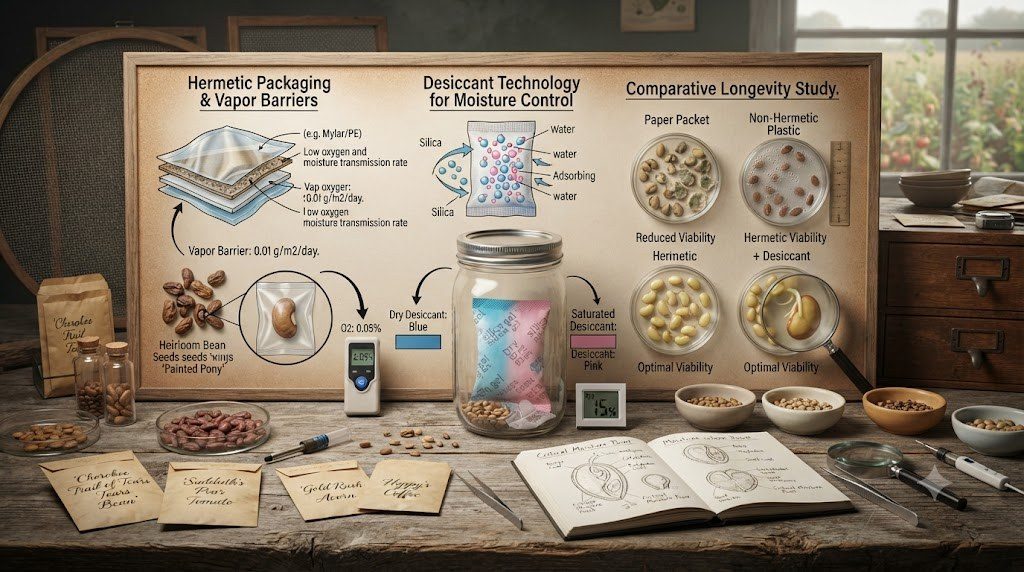
- Multi-Layer Laminated Barrier Foils (Mylar / PET / Aluminum Foil / LLDPE): The undisputed gold standard for professional seed preservation. These quad-laminate structures feature a central layer of pure solid aluminum foil (typically 7 to 12 microns thick) laminated between polyethylene terephthalate (PET) and linear low-density polyethylene (LLDPE). Solid aluminum foil provides a virtually zero transmission barrier: WVTR < 0.005 g/m^2/day and OTR < 0.005 cm^3/m^2/day. Seeds sealed inside heat-laminated foil pouches remain isolated from atmospheric fluctuations for decades.
2. Desiccant Technology: Silica Gel, Molecular Sieves, and Zeolites
When sealing dry seeds into hermetic containers, packaging engineers must account for the ambient air trapped inside the package headspace. Incorporating solid desiccating agents ensures that any residual moisture vapor is sequestered before it can equilibrate with the seed lot:
1. Silica Gel (Amorphous Silicon Dioxide): The most widely utilized commercial desiccant. Synthesized from sodium silicate, silica gel features an immense internal network of interconnected microscopic pores, providing an active surface area exceeding 700 to 800 square meters per gram. Silica gel adsorbs water via physical capillary condensation, capable of binding up to 30% to 35% of its dry weight in water at high relative humidity. Indicating silica gel incorporates non-toxic moisture indicators (such as methyl orange, transitioning from orange when anhydrous to dark green when saturated), providing visual verification of desiccant exhaustion.
2. Synthetic Zeolite Molecular Sieves (Type 4A): Crystalline aluminosilicates possessing uniform, atomically precise pore openings (4 Angstroms in diameter). Unlike silica gel—which adsorbs water weakly at low relative humidities—molecular sieves exhibit extreme chemical affinity for water molecules even at ambient humidities below 10%. They can strip residual moisture out of sealed containers down to water activity levels below $a_w = 0.05$.
3. Natural Clay Desiccants (Montmorillonite / Bentonite): Mined calcium aluminosilicate clays that offer a cost-effective, environmentally sustainable alternative for bulk packaging, retaining up to 25% moisture at 50% RH.
3. Modified Atmosphere Packaging: Nitrogen Flushing and Vacuum Sealing
Oxygen is a primary agent of seed aging. In the presence of atmospheric oxygen (21% $O_2$), polyunsaturated fatty acids embedded in seed membranes undergo slow, non-enzymatic autoxidation, producing lipid peroxides and reactive free radicals that damage DNA and nuclear proteins. Advanced packaging facilities employ Modified Atmosphere Packaging (MAP) to mitigate oxidative stress:
- Vacuum Packaging: Atmospheric air is mechanically evacuated from the pouch prior to impulse heat sealing. Removing air collapses the pouch tightly around the seed mass, eliminating internal oxygen and preventing abrasion between seed hulls during transit. However, vacuum packaging can exert physical pressure on fragile seed coats (such as wrinkled peas).
- Nitrogen (N2) Gas Flushing: The pouch headspace is purged with ultra-high-purity gaseous nitrogen (99.9% $N_2$) immediately before heat sealing, reducing residual oxygen concentrations below 0.5%. Because nitrogen is chemically inert and non-reactive, it provides a stable protective cushion that completely halts oxidative aging and suffocates any surviving insect pests (weevils, beetles) within the container.
- Oxygen Absorbers (Iron-Based Scavengers): Small sachets containing finely divided ferrous carbonate, sodium chloride, and activated carbon. The iron oxidizes chemically into ferric hydroxide ($Fe(OH)_3$), consuming all residual oxygen in the sealed package within 24 to 48 hours and dropping $O_2$ levels below 0.01%.
| Packaging Method | Moisture Barrier Level | Oxygen Barrier Level | Insect / Pest Protection | Typical Longevity at 20°C |
|---|---|---|---|---|
| Burlap / Jute Bag | Zero (Equilibrates instantly) | Zero (Free oxygen exchange) | Zero (Vulnerable to weevils/rodents) | 3 - 6 months in humid climates |
| Polyethylene (LDPE Bag) | Moderate (Slow vapor leak) | Low (Oxygen penetrates) | High against insects; low to rodents | 1 - 2 years maximum |
| Hermetic Cocoon (GrainPro) | High (eRH locked inside) | High (Bio-generated hypoxia) | 100% insect suffocation in 10 days | 3 - 5 years for bulk grain |
| Glass Mason Jar with Gasket | Absolute (Impermeable) | Absolute (When sealed tight) | 100% insect/rodent proof | 5 - 10 years (fragile transport) |
| Heat-Sealed Mylar Foil Pouch | Absolute (WVTR < 0.005) | Absolute (OTR < 0.005) | 100% impervious to light/insects | 10 - 25+ years (Optimal vault standard) |
4. On-Farm Hermetic Systems: The 'Purdue Improved Crop Storage' (PICS) Revolution
For smallholder farmers across sub-Saharan Africa, Latin America, and South Asia, commercial aluminum foil pouches are often economically inaccessible. In response, agricultural scientists developed the Purdue Improved Crop Storage (PICS) system—a low-cost hermetic triple-bagging technology that has transformed tropical post-harvest management.
A PICS unit consists of two interior high-density polyethylene (HDPE) liners (80 microns thick each) encased within an outer protective woven polypropylene sack. When dry grain and seeds (cowpeas, maize, sorghum, beans) are packed tightly into the inner liner and sealed with zip-ties, the living seeds and any trapped insects continue low-level aerobic respiration. Within 5 to 10 days, insect and seed respiration consumes the trapped oxygen, dropping $O_2$ from 21% down to below 3%, while carbon dioxide ($CO_2$) climbs to 15%–20%.
Under this bio-generated hypoxia, insect larvae, adult bruchid weevils (Callosobruchus maculatus), and fungal spores suffocate and die without the application of toxic chemical insecticides. Field trials demonstrate that dry seeds stored in PICS bags maintain over 90% germination viability across 18 to 24 months under tropical ambient heat.
5. Heat Sealing Parameters: Temperature, Dwell Time, and Jaw Pressure
The integrity of a hermetic pouch depends entirely on the mechanical execution of its heat seal. A barrier pouch with a zero WVTR is useless if its closure seam harbors microscopic pinholes or incomplete welds. Industrial impulse and constant-heat sealers must be calibrated around three interdependent thermodynamic parameters:
- Sealing Temperature: Must match the melting point of the pouch's inner polymer sealant layer (typically linear low-density polyethylene, LLDPE, which melts between 120°C and 140°C). If the sealing bar temperature is too low (< 115°C), the polymer fails to flow, creating a 'cold seal' that separates under slight tension. If temperature exceeds 165°C, the inner polymer degrades and burns through, exposing the fragile aluminum barrier to pinhole leaks.
- Dwell Time: The duration (in seconds) the heated jaws remain clamped together under pressure. Standard laminated foils require a dwell time between 1.2 and 2.5 seconds to allow conductive heat transfer through outer PET and aluminum layers to the inner sealant core.
- Clamping Pressure: Sufficient pneumatic or mechanical pressure (typically 30 to 50 PSI) must be applied across the entire width of the sealing jaw to force molten polymer into any surface irregularities or dust particulates, guaranteeing a continuous hermetic weld.
Frequently Asked Questions (FAQ)
Q: What does WVTR mean in seed packaging science?
WVTR stands for Water Vapor Transmission Rate—the measured amount of water vapor (in grams) passing through one square meter of a barrier film over 24 hours under standardized temperature and humidity conditions.
Q: Why are Mylar foil pouches considered the best packaging for long-term seed storage?
Mylar pouches incorporate a central core of solid aluminum foil laminated between protective plastic layers. This provides a virtually impenetrable barrier to moisture vapor, oxygen, and ultraviolet light.
Q: How does an iron-based oxygen absorber work inside a sealed seed pouch?
It contains finely divided ferrous powder that chemically reacts with trapped oxygen in the presence of ambient moisture to form iron oxide (rust), permanently locking up oxygen molecules and dropping O2 levels below 0.01%.
Q: Can you seal seeds in a Mylar bag with a regular household clothing iron?
Yes. A household clothing iron set to the medium/wool setting (approx. 130°C to 150°C) applied firmly along the pouch lip over a flat wooden edge for 2 to 3 seconds creates an effective hermetic seal.
Q: What is indicating silica gel and how does it signal moisture saturation?
Indicating silica gel is impregnated with a non-toxic pH indicator dye (such as methyl orange) that changes color from orange when dry to dark green when saturated, alerting the curator that regeneration is required.
Q: How do you recharge exhausted silica gel desiccants?
Exhausted silica gel is baked on a flat tray in a conventional oven at 110°C to 125°C for 2 to 3 hours. The heat drives off absorbed water vapor, restoring its original color and adsorption capacity.
Q: Why can't seeds be stored long-term in standard Ziploc polyethylene sandwich bags?
Standard sandwich bags are made of thin low-density polyethylene (LDPE), which is highly permeable to water vapor over time. Over 6 to 12 months, ambient moisture penetrates the plastic, spoiling dry seeds.
Q: How do PICS bags kill grain weevils without using chemical pesticides?
PICS bags use triple-layer hermetic sealing. Living insects and seeds consume the trapped oxygen through natural respiration, dropping O2 levels below 3% within days and suffocating all insect stages.
Q: What is the risk of using an impulse sealer with contaminated sealing jaws?
If seed dust, chaff, or oil contaminates the sealing bar, it prevents the molten polymer from fusing cleanly, creating microscopic capillary channels (pinholes) that leak water vapor into the package.
Q: Should seeds be vacuum-sealed if they are being frozen at -20°C?
Yes. Vacuum sealing or nitrogen flushing prevents moisture condensation inside the pouch when freezing and prevents air expansion or puncture during temperature cycling in gene bank freezers.
Q: What is the difference between Type 4A molecular sieves and silica gel?
Type 4A molecular sieves are crystalline aluminosilicates with uniform 4-angstrom pores that bind water aggressively even at ultra-low relative humidities (< 10% RH), whereas silica gel works best above 20% RH.
Q: Can glass mason jars provide a true hermetic barrier for seed storage?
Yes. Glass is completely impermeable to water vapor and oxygen. As long as the rubber lid gasket is intact, clean, and clamped tightly, glass jars provide an outstanding hermetic storage container.
Q: Why should you allow a frozen, sealed seed pouch to reach room temperature before opening?
If a freezing pouch is opened immediately, cold seeds act as a condenser for warm room air. Water vapor instantly condenses onto the seeds as liquid dew, destroying their dry state.
Q: How do you test a heat seal for microscopic leaks in a quality control lab?
Technicians perform a dye penetration test or submerge the sealed pouch in a water vacuum chamber. Decreasing external chamber pressure causes internal air to escape as visible bubbles if leaks exist.