Among all surgical interventions practiced in agricultural botany, none is more ancient, economically indispensable, or biologically sophisticated than the art and science of grafting and budding. Practiced for millennia across the fertile river valleys of China, ancient Greece, and Rome, grafting is the deliberate surgical unification of two distinct botanical plant parts—the scion (the aerial shoot or bud) and the rootstock (the rooted understock)—so that their vascular tissues fuse, forming a permanent, functioning composite plant.
In modern commercial fruit orchards, vineyards, and high-tech greenhouse vegetable production, virtually every apple, pear, citrus, sweet cherry, European wine grape, commercial greenhouse tomato, and seedless watermelon is a grafted organism. Grafting is not merely a method to clone elite varieties; it is a precision biological technology that confers absolute dwarfing control, drought and salinity tolerance, and immunity against lethal soil-borne pathogens like phylloxera, nematodes, and Fusarium wilt. Understanding the micro-anatomy of vascular cambium alignment, the physiological stages of graft union formation, hormonal callus proliferation, and genetic graft incompatibility is mandatory for commercial propagators. This comprehensive treatise explores the cellular mechanics, surgical methodologies, physiological signaling, and incompatibility dynamics of plant grafting.
1. The Anatomical Imperative: Vascular Cambium Alignment
The biological success or catastrophic failure of any graft union hinges entirely on a single microscopic cellular layer: the vascular cambium. The vascular cambium is a continuous, cylindrical lateral meristem located between the outer phloem (bark) and the inner xylem (wood). In woody dicot stems, the cambium is only one to five cells thick, consisting of actively dividing fusiform initials (which produce vertical vascular elements) and ray initials (which produce horizontal vascular rays).
For a graft to heal, the vascular cambium of the scion must be placed in direct, intimate, pressurized physical contact with the vascular cambium of the rootstock. If a propagator aligns the outer bark but leaves a microscopic gap between the cambium layers, or crosses the cambium lines at a skewed angle, callus bridges cannot span the divide. The scion continues to transpire water through its buds, desiccates within 7 to 10 days, and dies of thirst before vascular continuity can be established.
2. The Five Cytological Stages of Graft Union Formation
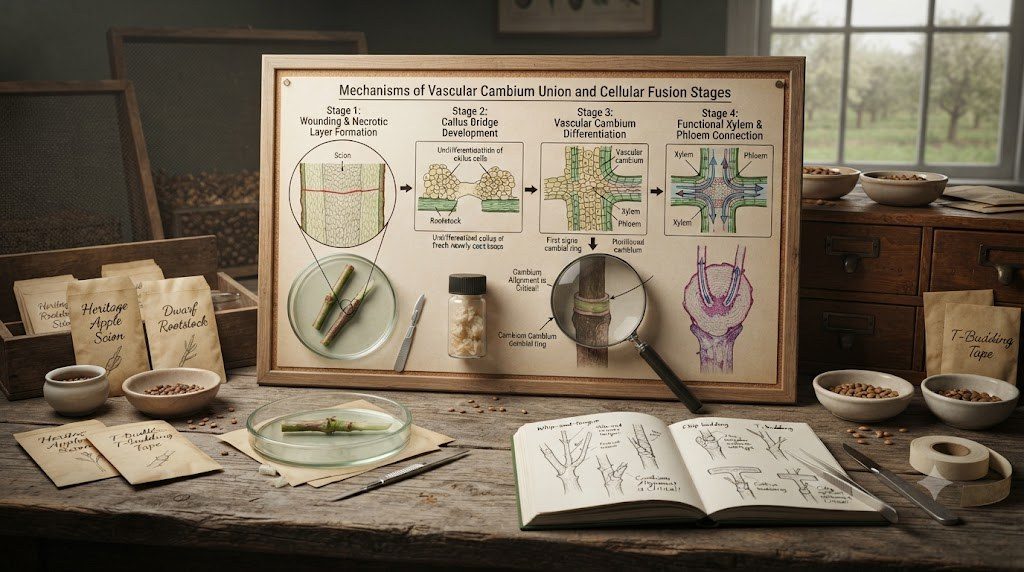
The fusion of two genetically distinct stems into a single vascular entity is an extraordinary process of wound healing and tissue regeneration that unfolds through five distinct cytological stages:
- Stage 1 — Surgical Contact and Necrotic Plate Formation (Day 0 to 3): The surgical incisions sever thousands of plant cells. Damaged cell contents spill across the interface, oxidizing into a dark, suberin- and pectin-rich seal known as the necrotic isolation layer. This layer temporarily binds the scion and stock together and limits desiccation. High clamping pressure applied by grafting tape or elastic bands is vital to hold the surfaces immobile.
- Stage 2 — Wound Callus Proliferation (Day 3 to 8): Undifferentiated, living parenchyma cells located immediately adjacent to the vascular cambium in both scion and stock begin rapid mitotic division. Pectins in the expanding callus cells dissolve and absorb the necrotic plate. The burgeoning callus masses interlock, filling the surgical void with an unorganized, spongy cellular bridge.
- Stage 3 — Cellular Communication and Cohesion (Day 8 to 12): Cells of the scion and rootstock establish physical contact. Plasma membranes fuse through the de novo formation of functional secondary plasmodesmata spanning the inter-species graft interface. Symplastic transport of sugars, amino acids, and hormonal signals commences between the two distinct organisms.
- Stage 4 — Differentiation of the Wound Cambium (Day 12 to 18): Guided by endogenous auxin (IAA) streaming down basipetally from active buds on the scion, parenchyma cells in the center of the callus bridge undergo targeted differentiation into a new, continuous wound vascular cambium, seamlessly bridging the gap between the original cambiums of scion and stock.
- Stage 5 — Vascular Bridging and True Connection (Day 18 to 28+): The newly formed wound cambium produces secondary xylem toward the interior and secondary phloem toward the exterior. Continuous xylem vessel elements perforate, restoring hydraulic transpiration stream pressure from the roots to the scion leaves, completing the graft union.
3. Classical Surgical Methodologies: Whip-and-Tongue, Cleft, and T-Budding
Horticultural science has developed specialized surgical grafting cuts adapted to specific stem diameters and operational timing:
- Whip-and-Tongue Grafting: The undisputed gold standard for dormant bench grafting in fruit nurseries when the scion and rootstock share identical diameters (6 to 12 mm). Both stems receive matching smooth sloping cuts (2.5 to 3.5 cm long), followed by interlocking reverse downward cuts that form matching ‘tongues.’ When pushed together, the tongues interlock with rigid mechanical friction, maximizing cambial contact area and resisting mechanical displacement even before wrapping.
- Cleft Grafting (Top-Working): Used to change varieties on mature orchard trees where the rootstock branch is significantly wider than the scion (stock diameter 25 to 75 mm; scion diameter 8 to 10 mm). The stock limb is sawed off cleanly and split vertically down the center with a grafting chisel. Two scions cut into long, tapered wedges are inserted into the outer edges of the cleft, with their cambium lines meticulously aligned with the rootstock cambium.
- T-Budding (Shield Budding): The dominant commercial method for summer nursery propagation of stone fruits (peaches, cherries, plums) and roses. Performed in mid-to-late summer when the rootstock bark is ‘slipping’ (the vascular cambium is actively dividing, allowing bark to peel cleanly from the wood). A vertical incision and horizontal crosscut form a ‘T’ in the stock bark. A single mature vegetative bud sliced with a shield-shaped sliver of bark is slipped downward into the T-pocket and wrapped tightly, leaving the bud exposed.
- Chip Budding: Replaces T-budding in modern automated nurseries. Uses matching chip cuts excised from the scion and stock. Because chip budding does not require the bark to ‘slip,’ it can be performed in early spring, mid-summer, or late autumn, providing nursery managers with total seasonal flexibility.
| Grafting Technique | Relative Stem Diameters | Optimal Seasonal Timing | Cambial Contact Area | Primary Commercial Application |
|---|---|---|---|---|
| Whip-and-Tongue | Equal diameter (6 – 12 mm) | Late winter / Dormant spring | Exceptionally high (Interlocking tongues) | Bench grafting apples, pears, grapevines |
| Cleft Grafting | Stock much wider than scion | Early spring (Before budbreak) | Moderate (Aligned on outer edges) | Top-working established orchard canopies |
| T-Budding (Shield) | Bud onto young vigorous stock | Mid to late summer (Bark slipping) | High (Fits tightly inside T-flap) | Commercial nursery stone fruits & roses |
| Chip Budding | Stock equal or wider than bud | Spring, Summer, or Autumn | High (Exact geometric excision) | Premier commercial fruit & ornamental cloning |
| Splice / Hole Insertion | Herbaceous seedlings (2 – 3 mm) | Controlled greenhouse chamber | High (Held by silicone clips) | Grafted greenhouse tomatoes, melons, watermelons |
4. Graft Incompatibility: Biochemical Incompatibility vs. Translocation Failure
Plants cannot be grafted indiscriminately across the plant kingdom. While grafting within the same botanical species (intra-specific, such as ‘Gala’ apple onto ‘M.9’ apple) is virtually 100% compatible, grafting between different genera or families almost universally fails. When incompatible plants are grafted, they exhibit graft incompatibility, categorized into two physiological classes:
1. Non-Translocatable (Localized) Incompatibility: Occurs when structural vascular cambium bridges fail to form cleanly at the graft interface, resulting in a weak, brittle joint held together only by spongy, unlignified callus cells. A classic example is grafting ‘Bartlett’ pear (Pyrus communis) directly onto Quince rootstock (Cydonia oblonga). The graft may grow for several seasons, but breaks off cleanly under the weight of a heavy fruit crop or moderate wind gust. This localized incompatibility can be completely overcome by inserting a compatible interstock (interstem)—such as ‘Old Home’ or ‘Beurre Hardy’ pear—between the quince rootstock and the Bartlett scion.
2. Translocatable Incompatibility: Caused by systemic biochemical warfare across the graft union. In peach (Prunus persica) grafted onto ‘Myrobalan’ plum (Prunus cerasifera), the plum rootstock naturally synthesizes the cyanogenic glucoside prunasin. When prunasin crosses the graft union into the peach phloem, the peach tissue hydrolyzes it, releasing toxic hydrogen cyanide ($HCN$). The cyanide destroys the peach phloem tissue, completely halting downward carbohydrate transport. The roots starve, leaves turn yellow and scorch, and the entire tree collapses within a single season.
5. Environmental Parameters for Callus Formation: Temperature and Relative Humidity
A beautifully executed surgical cut will fail instantly if post-graft environmental conditions are neglected. Callus cells are thin-walled, fragile parenchyma cells that lack cuticular wax; if ambient relative humidity drops below 95%, exposed callus desiccates within hours, aborting the union.
Furthermore, callus mitosis is intensely temperature-dependent: for temperate fruit trees (apples, pears, grapes), optimum callus proliferation occurs between 20°C and 25°C (68°F to 77°F). Below 10°C, callus cell division ceases entirely; above 32°C, callus cells rapidly senesce. Commercial operations utilize hot-callus pipes (callus callusing benches): local electric heating cables warm the precise physical graft union zone to 24°C, while the rootstock roots and scion buds are maintained in a refrigerated cold room at 4°C. This allows the vascular union to heal completely over 14 to 21 days without triggering premature budbreak on the scion.
Frequently Asked Questions (FAQ)
Q: What is the single most critical factor for a successful graft union?
The precise physical alignment and intimate contact between the vascular cambium layer of the scion and the vascular cambium layer of the rootstock under continuous mechanical pressure.
Q: What is the difference between grafting and budding?
Grafting uses a scion containing multiple vegetative buds attached to a stick of dormant stem. Budding (bud grafting) uses a single vegetative bud excised with a small shield or chip of bark.
Q: What is callus tissue and what is its role in graft healing?
Callus is an unorganized mass of proliferating parenchyma cells produced by wounded cells adjacent to the cambium. Callus cells interlock to form a living bridge between scion and stock.
Q: Why does a scion die if its buds break open before the graft union heals?
Expanding leaves transpire water rapidly through stomata. If leaves emerge before new xylem vessels have bridged the union, the scion exhausts its internal moisture and desiccates to death.
Q: What does it mean when orchardists say the bark is ‘slipping’?
It means the vascular cambium is actively dividing in spring/summer, creating a soft, fluid cell layer that allows the outer bark to peel cleanly away from the underlying wood without tearing.
Q: What is an interstock (interstem) and why is it used in fruit trees?
An interstock is a short stem piece grafted between an incompatible scion and rootstock, acting as a compatible biological bridge that allows two incompatible cultivars to grow together successfully.
Q: Why must grafted joints be sealed with grafting wax or parafilm tape?
Sealing prevents water vapor loss from the exposed surgical cuts. If exposed cambium and callus cells dry out below 95% humidity, they die, preventing vascular bridging.
Q: Can plants from two completely different plant families be grafted together?
With rare exceptions, inter-family grafts fail completely. Grafting is generally successful only between cultivars of the same species or closely related species within the same botanical genus.
Q: What is top-working in commercial fruit orchards?
Top-working is grafting new scion varieties onto the main scaffold branches of an established mature orchard tree, changing the commercial fruit variety of the entire orchard in a single season.
Q: How does a hot-callus pipe bench improve bench grafting success?
It heats only the physical graft union to 22°C-25°C to accelerate rapid callus division, while keeping roots and scion buds cold at 4°C to prevent premature leaf growth.
Q: Why are commercial European wine grapes always grafted onto American rootstocks?
European vines (Vitis vinifera) are fatally susceptible to the soil aphid phylloxera. Grafting them onto native American grape rootstocks provides complete root immunity while preserving European grape flavor.
Q: What is the difference between localized and translocatable graft incompatibility?
Localized incompatibility produces a weak, brittle mechanical joint that can be fixed with an interstock. Translocatable incompatibility involves chemical toxins that travel systemically and kill the tree.
Q: Why are vegetable crops like tomatoes and watermelons grafted today?
Grafting tomatoes and watermelons onto wild solanaceous or cucurbit rootstocks provides complete immunity against soil-borne nematodes, Fusarium wilt, and Verticillium wilt without chemical soil fumigation.
Q: What happens if grafting tape is left wrapped around a growing branch too long?
As the stem expands in diameter, old non-degrading plastic tape girdles the branch, strangling the phloem and causing the graft union to swell abnormally and snap in the wind.