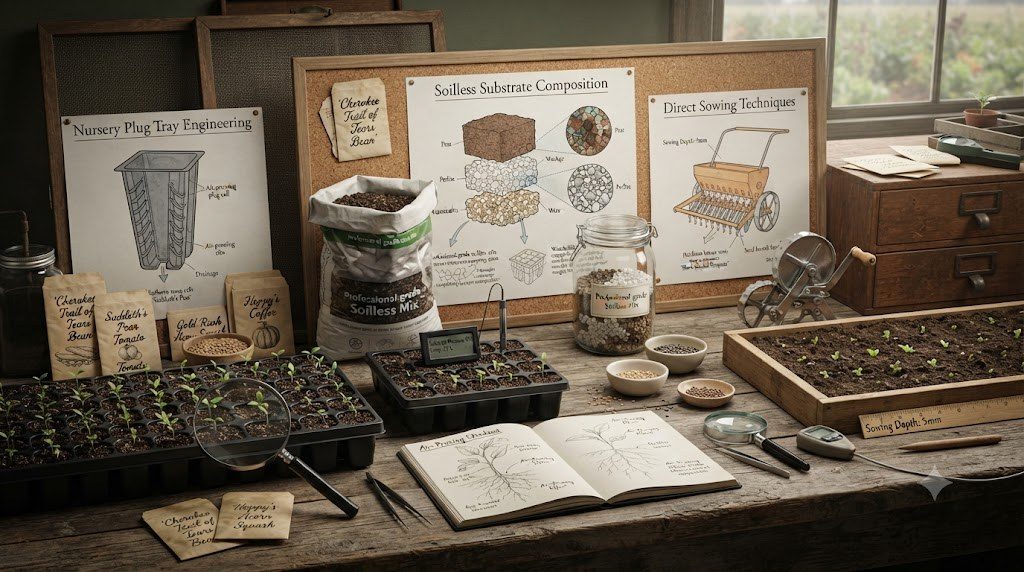
In commercial greenhouse nursery production and precision field agriculture, the physical architecture of the germination zone—the seedbed—is the primary technological determinant of crop establishment. The critical transition from a dormant seed into an autotrophic, photosynthesizing seedling represents the most vulnerable window in the plant life cycle. During this sensitive 14-day window, the emerging radicle and shoot axis possess virtually zero defense against soil compaction, hypoxia, waterlogging, salt toxicity, or parasitic soil-borne pathogens.
Engineering an optimal seedbed requires a multidisciplinary mastery of substrate physics, container geometry, hydraulic capillary conductivity, and mechanical sowing depth dynamics. Propagators must navigate the technological divide between direct field sowing (deploying precision pneumatic seed drills into cultivated soil tilth) and containerized plug tray nursery production (utilizing calibrated soilless substrates in automated greenhouse ranges). Understanding air-filled porosity, matric water retention, container height hydraulics, and mechanized seedling transplanting is essential for commercial growers seeking 100% stand establishment. This comprehensive treatise explores the engineering, physics, substrate formulations, and seedling management protocols of modern seedbeds.
1. Substrate Physics: Air-Filled Porosity (AFP) and Container Capacity
In containerized nursery seedling production, conventional agricultural field soil cannot be used. When topsoil is scooped into a 5-centimeter plug cell, its natural aggregate structure collapses, destroying macro-pores and forming a dense, suffocating mud upon watering. Modern nursery seedbeds rely strictly on formulated soilless substrates engineered around two fundamental physical parameters:
- Container Capacity (Water-Holding Capacity, CC): The maximum volume of water retained by a soilless substrate following saturation and complete gravitational drainage. High container capacity ensures emerging seedlings have access to continuous moisture without requiring hourly irrigation. Ideal nursery plug substrates maintain a container capacity between 55% and 70% by volume.
- Air-Filled Porosity (AFP): The volume of air-filled macro-pores remaining in the substrate after gravitational drainage has ceased. Actively respiring roots and germinating seeds consume immense quantities of oxygen ($O_2$). If AFP falls below 10%, gas diffusion slows to a crawl, cellular respiration shifts to anaerobic fermentation, and roots rot within 48 hours. Optimal seed germination substrates mandate an AFP between 15% and 25% by volume.
- Total Porosity (TP): The sum of water-filled micro-pores and air-filled macro-pores ($TP = CC + AFP$), typically exceeding 80% to 85% by volume in professional germination mixes.
2. Formulating the Modern Germination Matrix: Peat, Coir, and Perlite
Commercial greenhouse propagation mixes are precision blends of organic fiber bases and inorganic aggregate conditioning minerals:
1. Sphagnum Peat Moss (Horticultural Grade): Harvested from pristine sub-Arctic bogs, light brown fibered blonde peat (H2–H4 on the von Post humification scale) forms the backbone of premium mixes. Peat cells (dead hyaline cells) feature hollow, porous structures that hold up to 15 to 20 times their dry weight in water while maintaining cellular resilience against compaction. Virgin peat is naturally acidic (pH 3.5 to 4.5) and must be buffered with finely pulverized dolomitic limestone (calcium and magnesium carbonate) at a rate of 4 to 6 kilograms per cubic meter to raise the pH to the optimal 5.8–6.2 range.
2. Coconut Coir Pith (Coir Dust): A renewable organic byproduct of coconut husks (Cocos nucifera). Coir has a natural pH closer to neutral (5.8 to 6.5) and re-wets effortlessly from a dry state without requiring synthetic surfactant wetting agents. However, unwashed agricultural coir harbors dangerous levels of sodium ($Na^+$) and chloride ($Cl^-$) ions adsorbed onto its cation exchange sites. Commercial nursery coir must be calcium-buffered (washed with calcium nitrate solutions) to displace excess salts before incorporation into germination blends.
3. Expanded Horticultural Perlite: A natural volcanic aluminosilicate glass heated rapidly to 900°C–1,000°C, causing trapped moisture to vaporize and expanding the mineral granules like popcorn into sterile, ultra-lightweight white particles. Perlite particles are closed-cell granules that do not absorb water internally; they function purely as inert physical spacers, creating rigid macro-pores that provide permanent air-filled porosity (AFP) throughout the plug tray.
4. Exfoliated Vermiculite (Super-Fine Grade): A hydrated laminar magnesium-aluminum-iron silicate mineral that expands into accordion-like lamellar flakes when heated. Vermiculite possesses an exceptionally high Cation Exchange Capacity (CEC: 100 to 150 meq/100g), buffering against nutrient fluctuations and acting as the premier moisture-retaining cover layer dusted over freshly sown seed trays.
3. Plug Tray Engineering: Cell Geometry, Volumes, and Root Air-Pruning
The transition from open wooden seed flats to specialized thermoformed plastic plug trays (plug cell flats) in the 1970s revolutionized global commercial horticulture. Plug trays provide individual, isolated root compartments for every seedling, eliminating root entanglement, preventing the transmission of damping-off pathogens between plants, and enabling automated robotic transplanting.
Plug tray cell counts and volumes are selected based on seedling crop architecture and production timing:
- 512-Cell & 288-Cell Trays (Ultra-High Density): Individual cell volumes ranging from 3.5 to 6.5 cubic centimeters. Used for small, fast-growing bedding annuals (petunias, begonias, pansies) and high-density commercial vegetables (onions, leeks, celery). Seedlings must be transplanted within 3 to 5 weeks; delaying transplanting causes severe root binding and irreversible stunting.
- 128-Cell & 72-Cell Trays (Intermediate / High Vigor): Cell volumes ranging from 15 to 35 cubic centimeters. The commercial standard for fruiting solanaceous vegetables (tomatoes, peppers, eggplants) and brassicas. Provides sufficient root volume to sustain vigorous vegetative growth for 5 to 7 weeks prior to field transplanting.
- 50-Cell & 38-Cell Deep Cell Trays: Deep, elongated cells (often 10 to 12 cm deep, volume > 80 cm³). Engineered for deep-rooting native perennials, forestry trees, and woody shrubs. Features vertical internal root-training ribs that prevent root spiraling, directing roots downward toward open bottom drainage holes.
- Air-Pruning Technology: High-tech propagation trays feature open lattice slots along the cell walls. When root tips hit open air, the tip desiccates and dies naturally—a process called air-pruning. Air-pruning halts primary root elongation and triggers massive lateral branching throughout the cell core, producing a dense, highly fibrous root plug that establishes instantaneously in field soils without transplant shock.
| Plug Tray Standard | Cell Volume (cm³) | Cells per Standard Flat (11x21 in) | Optimal Seedling Crops | Target Nursery Dwell Time |
|---|---|---|---|---|
| 512 Plug Tray | 3.2 - 4.5 cm³ | 512 individual seedlings | Petunia, Begonia, Snapdragon, Celery | 18 - 25 days (Rapid shift) |
| 288 Plug Tray | 6.0 - 8.5 cm³ | 288 individual seedlings | Lettuce, Onion, Cabbage, Marigold | 24 - 32 days (High commercial standard) |
| 128 Plug Tray | 18.0 - 22.0 cm³ | 128 individual seedlings | Tomato, Bell Pepper, Eggplant, Zinnia | 35 - 45 days (Vigorous sturdy root ball) |
| 72 Plug Tray | 35.0 - 42.0 cm³ | 72 individual seedlings | Cucumber, Melon, Squash, Perennial herbs | 25 - 35 days (Avoid root spiraling) |
| 50 Deep Tree Pot | 85.0 - 110.0 cm³ | 50 deep-cell cavities | Oak, Pine, Walnut, Native woody shrubs | 60 - 90 days (Deep root tap architecture) |
4. Direct Field Sowing: Soil Tilth, Seed-to-Soil Contact, and Drill Mechanics
While greenhouse plug trays dominate high-value horticulture, broadacre staple agriculture (corn, soybeans, wheat, cotton, carrots, canola) relies entirely on direct mechanical field sowing. Direct drilling eliminates nursery labor costs, but places the seed at the mercy of raw field conditions.
Successful field emergence depends on three mechanical parameters:
- Seedbed Tilth (Aggregate Sizing): A seedbed must not be pulverized into fine powder; fine dust forms a rock-hard impermeable crust following rain. Optimal tilth consists of a granular mixture where 50% to 70% of soil aggregates are between 1.0 and 5.0 millimeters in diameter. This provides intimate seed contact while preserving continuous macro-pore channels for oxygen and water infiltration.
- Seed-to-Soil Contact and Hydraulic Conduction: Liquid water migrates from soil particles into the seed via unsaturated hydraulic capillary flow. Modern planting drills deploy specialized rubber press wheels or cast-iron V-firming wheels that apply calibrated down-pressure (typically 20 to 50 PSI) directly over the seed furrow, pressing moist soil firmly against the seed coat to eliminate insulating air gaps.
- Precision Depth Dynamics (The 2x to 3x Rule): The universal agronomic rule dictates that seeds should be planted at a depth equal to two to three times their minor seed diameter. Small seeds (like carrots or alfalfa) require shallow sowing (0.5 to 1.0 cm) to ensure delicate hypocotyls reach light before energy reserves are exhausted. Large seeds (like corn or beans) are sown deep (3.5 to 5.0 cm) to place the embryo below the dry surface dust layer into consistently moist subsoil.
5. Automated Nursery Irrigation: Boom Systems vs. Sub-Irrigation
Managing water delivery in commercial seedling ranges requires engineering systems that hydrate substrates uniformly without causing mechanical seedling displacement or spreading foliar diseases:
Overhead Traveling Irrigation Booms: Automated overhead booms travel back and forth across nursery greenhouse bays on overhead rails. Computer-controlled booms deploy precision micro-nozzles applying uniform droplet sizes (200 to 400 microns) under steady water pressure. Booms eliminate the human error of hand-watering, delivering exact milliliter volumes to every cell in a 50,000-seedling range.
Ebb-and-Flow (Flood-and-Drain) Sub-Irrigation: The gold standard for modern clean greenhouse production. Seedling trays sit in shallow watertight aluminum benches. Warm water and nutrient solution is pumped into the bench, flooding the trays from below to a depth of 2.0 to 3.0 centimeters for 10 to 15 minutes. Water rises into the plug cells via capillary wicking through the bottom drainage holes. The water is subsequently drained back into holding tanks, leaving seedling foliage completely dry. Keeping leaves dry reduces fungal damping-off (Pythium and Rhizoctonia) and foliar blights by over 90% compared to overhead watering systems.
Frequently Asked Questions (FAQ)
Q: Why shouldn't you use garden soil in seedling plug trays?
Garden soil compacts tightly inside small container cells, collapsing macro-pores. It holds too much water, blocks oxygen diffusion to the roots, and frequently harbors damping-off pathogens.
Q: What is Air-Filled Porosity (AFP) and why is it vital for germination?
AFP is the volume percentage of air-filled macro-pores remaining in a substrate after water drains. Seedling roots require an AFP between 15% and 25% to obtain oxygen for active cellular respiration.
Q: Why is expanded perlite added to soilless seed starting mixes?
Perlite granules are porous, sterile volcanic glass particles that act as physical spacers in the mix, permanently preserving drainage channels and air-filled porosity without breaking down.
Q: What is the 'Perched Water Table' in shallow seedling flats?
In any container, capillary suction holds a permanent water-saturated layer at the bottom. In shallow plug trays, this water table occupies a high percentage of the cell, requiring coarse mixes to force drainage.
Q: How does air-pruning work in specialized nursery plug trays?
When root tips grow through slots in the cell wall, exposure to dry air causes the tip to desiccate and die naturally. This halts root circling and stimulates dense, fibrous branching throughout the plug.
Q: Why must commercial coconut coir be buffered with calcium before use?
Raw coir naturally holds high levels of sodium and potassium on its cation exchange sites. Buffering with calcium nitrate displaces these toxic salts, preventing sodium toxicity in young seedlings.
Q: What is the general rule of thumb for seed planting depth?
The universal agronomic rule is to sow seeds at a depth equal to 2 to 3 times their diameter. Sowing too deep exhausts the embryo's energy before reaching light; sowing too shallow causes desiccation.
Q: What is damping-off and how do you prevent it in the nursery?
Damping-off is seedling death caused by soil-borne fungi (Pythium, Rhizoctonia). It is prevented by using sterile soilless mixes, clean trays, excellent airflow, proper temperature, and sub-irrigation.
Q: Why do commercial growers prefer 288 plug trays for vegetable transplants?
A 288-cell tray provides an optimal balance between high production density (288 plants per flat) and sufficient soil volume to grow a healthy, transplantable seedling in 3 to 4 weeks.
Q: How does press wheel down-pressure help direct-seeded field crops?
Press wheels firm moist soil directly against the seed coat, eliminating air pockets and establishing intimate capillary contact so water can flow into the seed for rapid germination.
Q: Why is sub-irrigation (ebb-and-flow) superior to overhead watering for seedlings?
Sub-irrigation waters plants from below via capillary wicking, keeping seedling leaves completely dry. Dry foliage drastically suppresses fungal diseases like damping-off and botrytis.
Q: What role does dolomitic limestone play in peat-based seed mixes?
Sphagnum peat moss is naturally acidic (pH 3.5-4.5). Dolomitic limestone neutralizes the acidity to an optimal pH of 5.8-6.2 while providing essential calcium and magnesium nutrients.
Q: What happens if seedlings remain in high-density plug trays for too long?
Roots hit the cell walls and circle tightly, becoming root-bound. The plants quickly exhaust available nutrients, leading to premature flowering (bolting), woody stems, and permanent field stunting.
Q: Why is vermiculite used as a seed covering material in plug trays?
Fine vermiculite is lightweight, holds moisture exceptionally well without compacting, and allows light to filter through, making it ideal for covering delicate seeds to prevent desiccation.


