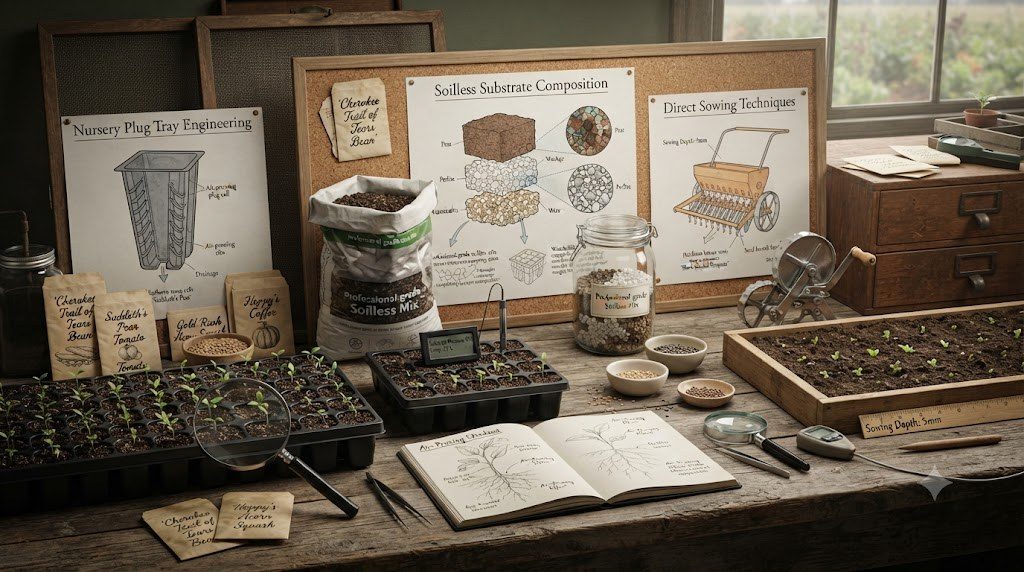
In modern high-speed mechanized agriculture and automated robotic greenhouse nurseries, the physical morphology of the seed is just as critical as its genetic pedigree. Nature engineered wild seeds with an astonishing array of irregular aerodynamic and dispersal shapes—from tiny, dust-like petunia and begonia seeds (measuring less than 0.3 millimeters) to angular, flat, and spiky carrot, onion, and lettuce seeds. In a mechanized planting tractor moving at 8 miles per hour, or an automated greenhouse drum seeder dropping 500 seeds per minute into plug trays, irregular seeds jam metering vacuum plates, bridge in delivery hoppers, and cause erratic ‘doubles’ or empty skips.
The industrial solution to this mechanical engineering challenge is seed coating technology. Through specialized physical modification processes categorized into pelleting, encrusting, and film-coating, agricultural engineers transform irregular, variable seeds into uniform, spherical, free-flowing biological capsules. Beyond physical standardization, modern seed coatings serve as sophisticated delivery platforms for micro-nutrients, systemic systemic pesticides, biological inoculants, and moisture-attracting hydrogels. This comprehensive treatise explores the binder chemistry, mineral matrix formulations, rotary coating machinery, and physical mechanics of industrial seed pelleting and film-coating.
1. Technological Categories: Film Coating, Encrusting, and Pelleting
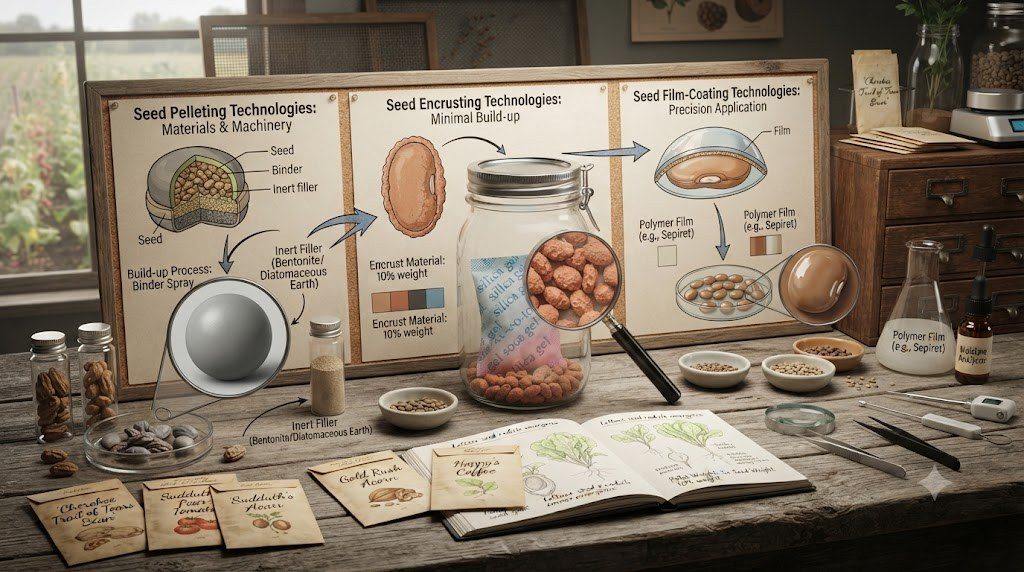
The American Seed Trade Association (ASTA) and the International Seed Testing Association (ISTA) classify seed coating technologies into three distinct structural categories based on mass addition and geometric transformation:
- 1. Film-Coating (Mass Increase: 1% to 5%): The continuous application of a microscopic, ultra-thin polymer film directly onto the contour of the seed coat without altering the seed’s original geometric shape or size. The film consists of synthetic polymers (polyvinyl acetate, hydroxypropyl methylcellulose, or acrylic emulsions) blended with color pigments (for safety identification) and chemical active ingredients (fungicides, insecticides, nematicides). Film-coating eliminates toxic chemical dust-off during shipping and mechanized handling.
- 2. Encrusting / Mini-Pelleting (Mass Increase: 50% to 500%): The application of mineral bulking fillers and liquid adhesives that smooth out irregular seed contours and add substantial physical weight, while still retaining the general oblong or oval silhouette of the seed. Encrusting improves singulation in pneumatic belt planters without building the massive volume of a true pellet, dominant in commercial sugar beet, onion, and brassica field crops.
- 3. Full Pelleting (Mass Increase: 800% to 4,000%+): The complete physical transformation of minute, lightweight, or irregularly shaped seeds (such as lettuce, petunia, celery, and tobacco) into uniform, perfectly spherical, marble-like pellets. A tiny lettuce seed weighing 1.2 milligrams is transformed into a dense, calibrated spherical pellet weighing over 15 to 25 milligrams. These pellets allow precision vacuum-drum greenhouse seeders to drop single seeds into plug trays with 99.8% mechanical accuracy.
2. Coating Matrix Chemistry: Binders, Fillers, and Disintegrants
Formulating a commercial seed pellet requires sophisticated material science. A pellet must satisfy two diametrically opposed physical criteria: it must be physically hard and durable enough to withstand shipping abrasion and mechanical tractor hoppers without cracking (zero friability), yet upon planting, it must soften and split open instantaneously when in contact with soil moisture, without presenting any physical barrier to oxygen diffusion or radicle emergence.
A modern pelleting matrix consists of three precisely balanced chemical components:
- Mineral Bulking Fillers (80% to 90% by dry weight): Inert, finely pulverized minerals ground to particle sizes between 10 and 50 microns. The primary filler is calcined diatomaceous earth (DE), prized for its high porosity, low bulk density, and exceptional gas permeability. Other common fillers include pulverized kaolin clay, micronized calcium carbonate ($CaCO_3$), talc, and expanded vermiculite dust.
- Polymeric Adhesives & Binders (1% to 5% by dry weight): Water-soluble or water-dispersible polymers that bind the mineral filler particles together and adhere the matrix to the seed coat. Formulations utilize hydroxypropyl methylcellulose (HPMC), polyvinyl alcohol (PVA), carboxymethyl cellulose (CMC), natural gum arabic, or modified starches. The binder concentration is critical: excess binder turns the pellet into an impermeable concrete shell that suffocates the embryo; insufficient binder causes the pellet to crumble into dust.
- Disintegrants & Splitting Agents (2% to 8% by dry weight): Super-absorbent polymers, modified microcrystalline cellulose, or swelling bentonite clays. When the pellet absorbs soil moisture, the disintegrant swells violently within minutes, creating internal hydrostatic pressure that causes the pellet to split open cleanly along a pre-engineered fracture line, exposing the seed to soil air and moisture.
3. Industrial Application Machinery: Rotary Pans and Fluidized Beds
Applying coatings to millions of delicate seeds requires specialized industrial engineering machinery:
1. Rotary Coating Pans (Centrifugal Coating Drums): The dominant technology for full pelleting and encrusting. Seeds are placed inside a deep, rotating stainless steel drum tilted at an angle (typically 30° to 45°). As the drum rotates, the seeds tumble smoothly in an orderly, continuous cascade. Automated peristaltic pumps spray fine atomized mists of liquid binder onto the tumbling seed mass, while pneumatic powder feeders dust calibrated streams of dry mineral filler. The liquid and powder build concentric layers around each seed until electronic optical sensors verify that the target spherical diameter has been achieved.
2. Rotary Centrifugal Coaters (R-Series Batch Coaters): Ideal for rapid film-coating and encrusting. Features a vertical cylindrical chamber with a spinning rotor plate at the bottom. Seeds are spun into a toroidal (doughnut-shaped) vortex, while a spinning dispersion cup at the center flings atomized liquid chemical slurries directly into the tumbling seed ring, achieving 100% uniform film coverage in less than 30 to 45 seconds per batch.
3. Fluidized Bed Coaters: Utilized for fragile or ultra-small seeds. Compressed heated air is forced upward through a conical chamber, levitating the seeds in a suspended fluid-like air cushion. Atomizing nozzles spray liquid polymer slurries onto the floating seeds, which dry instantaneously in the warm airflow, preventing seeds from sticking together (twinning).
| Coating Category | Matrix Thickness | Singulation Accuracy | Oxygen Transmission | Typical Seed Applications |
|---|---|---|---|---|
| Raw Uncoated Seed | 0.0 microns | Variable (Jams/Skips common) | Unrestricted (Natural testa) | Direct farm drilling; wild broadcasting |
| Polymer Film-Coat | 5 to 15 microns | Unchanged; eliminates dust | High (> 90% natural rate) | Corn, soybean, cotton, canola, cereals |
| Encrusted / Mini-Pellet | 50 to 250 microns | High (85% – 95% single drop) | Moderate to high | Onion, carrot, sugar beet, brassicas |
| Full Heavy Pellet | 500 to 1,500 microns | Exceptional (99.8% precision) | Dependent on matrix porosity | Lettuce, petunia, begonia, celery, tobacco |
| Hydrogel Retention Pellet | 300 to 800 microns | High (Pre-formed beads) | Moderate; locks moisture | Rangeland restoration, desert revegetation |
4. Bio-Active Ingredient Delivery: Nutrients, Inoculants, and Micro-Dosing
Modern seed coating has evolved far beyond physical sizing; it is an active biochemical delivery system. Instead of broadcasting fertilizers and pesticides across an entire field, coating technology allows agronomists to micro-dose active ingredients directly onto the spermosphere where the germinating seedling needs them most:
- Rhizobial Inoculant Encapsulation: Legume seeds (alfalfa, clover, soybeans) are coated with peat-based formulations containing live, symbiotic nitrogen-fixing bacteria (Rhizobium and Bradyrhizobium). The coating matrix incorporates specialized sticker polymers and protective trehalose sugars that preserve bacterial viability for up to 6 to 12 months inside the dry commercial pellet.
- Micronutrient Stacks: Applying trace minerals—specifically zinc ($Zn$), manganese ($Mn$), molybdenum ($Mo$), and boron ($B$)—directly into the pellet matrix. Molybdenum is critical for nitrogenase enzyme function in legumes; delivering 5 grams of molybdenum directly via seed pellets replaces broadcasting hundreds of grams per acre.
- Systemic Insecticide Loading: Incorporating modern neonicotinoids or anthranilic diamides (such as chlorantraniliprole) into the film-coat protects young seedlings against devastating early-season pests (flea beetles, wireworms, seedcorn maggots) while reducing total pesticide active ingredient applied per hectare by more than 90% compared to broadacre spraying.
5. Quality Control Testing: Friability, Sieve Calibrations, and Emergence Assays
Commercial pelleted and film-coated seed lots must pass rigorous quality control testing certified by international seed testing authorities before market release:
- Friability & Dust-Off Testing (Heubach Dust Meter): The pelleted seed lot is tumbled inside a rotating mechanical drum under a constant airflow. Released dust particulates are captured on a filter paper and weighed on an analytical balance. Commercial standards mandate dust-off levels below 0.75 grams of dust per 100,000 seeds to prevent pesticide drift and protect commercial planting tractor operators.
- Sieve Size Calibration: Pelleted seeds are passed through vibrating precision round-hole screens. A commercial ‘Size 13.0’ pellet must calibrate strictly between 3.25 mm and 3.50 mm, guaranteeing that 99% of pellets fall within a 0.25 mm tolerance window for robotic seeding drums.
- Split-Time & Emergence Verification: Pellets are placed on moist filter paper at 20°C. Quality control mandates that over 95% of pellets must split open within 15 to 30 minutes of hydration, and final germination percentage must match the untreated raw seed control within ± 2%.
Frequently Asked Questions (FAQ)
Q: What is the primary purpose of seed pelleting in modern agriculture?
Seed pelleting transforms small, lightweight, or irregularly shaped seeds (like lettuce, petunias, and carrots) into uniform, spherical pellets that can be dropped with 99.8% precision by robotic seeding machines.
Q: What is the difference between film-coating and full pelleting?
Film-coating applies an ultra-thin polymer layer (1-5% mass increase) that follows the natural shape of the seed to bind pesticides and eliminate dust. Full pelleting adds 1,000% to 4,000% mass, turning the seed into a calibrated round sphere.
Q: What materials are used to make the shell of a pelleted seed?
Pellets are formulated with inert, porous mineral fillers (calcined diatomaceous earth, kaolin clay, calcium carbonate) bonded with water-soluble polymers (carboxymethyl cellulose, PVA) and disintegrant clays.
Q: Why does a pelleted seed need a disintegrant in its formula?
A disintegrant swells rapidly upon absorbing soil moisture, cracking open the hard pellet shell within minutes so water and oxygen can reach the seed without restricting radicle emergence.
Q: Can a seed pellet suffocate the embryo if planted in over-watered soil?
Yes. If low-porosity heavy clay pellets are over-watered, they can form an airtight paste that blocks oxygen diffusion, causing the respiring embryo to suffocate and die.
Q: What is encrusting or mini-pelleting?
Encrusting adds moderate weight (100-500% mass increase) to smooth out rough seed contours without making a perfectly round ball, widely used for field crops like onions, sugar beets, and brassicas.
Q: How does seed coating deliver beneficial nitrogen-fixing bacteria to legumes?
Legume seeds are pelleted with Rhizobium bacteria embedded in peat carriers and protective sugars, ensuring the bacteria awaken in the soil to form nitrogen-fixing root nodules.
Q: What is a Heubach Dust Test in seed coating quality control?
It is an industrial mechanical tumbling test that measures how much chemical dust rubs off coated seeds, ensuring dust levels remain below strict legal safety limits to protect farm workers and pollinators.
Q: Why do commercial pelleted seeds have a shorter shelf life than raw seeds?
The moisture and mechanical friction applied during pelleting can slightly age the embryo. Pelleted seeds typically store reliably for 1 to 2 years compared to 3 to 5 years for raw seeds.
Q: Can pelleted seeds be planted with standard garden seeders?
Yes. In fact, pelleted seeds are designed specifically to flow smoothly through standard mechanical plate seeders (like EarthWay planters) without jamming or dropping multiple seeds.
Q: Why are calcined diatomaceous earth minerals preferred as pellet fillers?
Calcined diatomaceous earth is highly porous and lightweight, maintaining micro-air channels throughout the pellet shell that ensure continuous oxygen diffusion to the breathing embryo.
Q: What is ‘twinning’ in industrial seed coating pans?
Twinning occurs when two seeds stick together during the liquid spraying phase, forming a double pellet. Advanced rotating coaters and airflow nozzles prevent twinning by keeping seeds in motion.
Q: Are seed coating polymers toxic to soil biology?
Commercial seed coatings use non-phytotoxic, biodegradable polymers (such as cellulose derivatives and polyvinyl alcohols) that break down naturally in soil moisture without leaving harmful residues.
Q: Why must pelleted seeds be kept consistently moist after planting?
If a pelleted seed dries out after initial watering, the partially dissolved pellet can re-harden into a dense crust that traps the emerging radicle. Consistent moisture is critical until germination is complete.