In the biophysical orchestration of plant life, temperature serves as the ultimate kinetic metronome. Unlike animals capable of homeostatic thermal regulation, seeds are poikilothermic organisms whose internal metabolic rates, enzymatic kinetics, membrane phase transitions, and hormonal catabolism are dictated entirely by the thermal energy of their immediate soil microenvironment. Every plant species has evolved an innate mathematical window of germination response characterized by three cardinal temperatures: the base temperature ($T_b$), the optimum temperature ($T_o$), and the ceiling or maximum temperature ($T_c$).
Quantifying how seeds respond to fluctuating soil temperatures is not merely an academic exercise; it is the mathematical foundation of modern agronomy, precision planting schedules, and predictive crop modeling. Through the concept of thermal time—expressed in growing degree-days or degree-hours (degree-Cd)—agronomists can accurately forecast field emergence dates across variable climatic seasons. Furthermore, understanding the phenomena of thermo-inhibition and secondary thermo-dormancy allows commercial growers to prevent catastrophic germination failures in high-value greenhouse and field crops. This comprehensive treatise explores the biophysical thermodynamics, enzymatic kinetics, thermal time models, and environmental thresholds governing seed germination.
1. The Cardinal Temperature Paradigm: Base, Optimum, and Ceiling
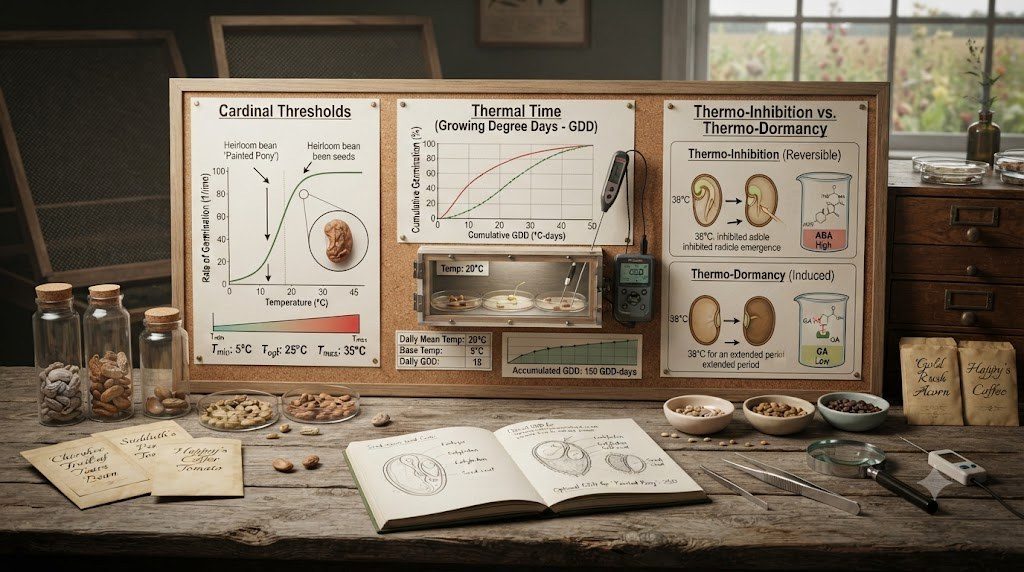
The germination response of any seed lot across a thermal gradient follows a characteristic non-linear biological curve defined by three cardinal parameters:
- The Base Temperature ($T_b$): The absolute minimum thermal threshold below which germination rate is mathematically zero. Below $T_b$, cellular membranes exist in a rigid, gel-like state; metabolic enzymes lack sufficient kinetic activation energy to drive the Krebs cycle; and water diffusion into embryonic cells is severely restricted. For cool-season temperate crops (such as peas, wheat, and lettuce), $T_b$ typically ranges from 1°C to 4°C. For warm-season tropical crops (such as corn, tomatoes, and cucurbits), $T_b$ lies between 8°C and 12°C.
- The Optimum Temperature ($T_o$): The specific thermal temperature (or narrow plateau) at which germination occurs in the shortest elapsed time—maximizing both germination velocity ($1/t_50$) and final germination percentage. At $T_o$, enzyme catalytic efficiency is maximized while structural proteins maintain conformational stability. Typical $T_o$ values range from 18°C to 22°C for cool-season crops and 28°C to 32°C for warm-season species.
- The Ceiling / Maximum Temperature ($T_c$): The upper thermal limit beyond which germination drops to zero. Above $T_c$, structural enzymes undergo thermal denaturation, lipid bilayers become hyper-fluid and leaky, and heat-shock transcription factors arrest normal protein synthesis. Prolonged exposure to temperatures exceeding $T_c$ induces irreversible embryonic death.
2. Thermal Time Modeling: The Mathematics of Heat Sums
In the sub-optimal temperature range—between the base temperature ($T_b$) and the optimum temperature ($T_o$)—the rate of germination ($1/t_g$, where $t_g$ is the time in days or hours required for a specific percentile $g$ of the seed population to germinate) exhibits a strikingly linear relationship with temperature ($T$):
1 / t_g = (T – T_b) / θ_T(g)
Where theta_T(g) is the thermal time constant (expressed in degree-days, deg Cd, or degree-hours) required for percentile g of the seed lot to emerge. Rearranging this linear equation reveals the fundamental thermal accumulation law of seed biology:
θ_T(g) = (T – T_b) × t_g
This mathematical model demonstrates that seeds do not respond to chronological calendar days; they respond to accumulated thermal units. If a spinach seed requires a thermal time constant of 50 degree-days (theta_T = 50 deg Cd) with a base temperature of T_b = 2 deg C, planting it in cold soil at 7°C will result in emergence taking 10 days ((7 – 2) × 10 = 50). If soil temperature rises to 12°C, emergence will take only 5 days ((12 – 2) × 5 = 50). Modern agricultural software uses these thermal time equations linked to real-time telemetry soil probes to direct precision robotic planting fleets.
3. Thermo-Inhibition vs. Secondary Thermo-Dormancy
When hydrated seeds encounter temperatures exceeding their optimum threshold, two distinct physiological suppression phenomena can occur, often observed in high-value vegetable crops like lettuce (Lactuca sativa) and celery (Apium graveolens):
1. Thermo-Inhibition (Reversible Thermal Suppression): Occurs when seeds are exposed to supra-optimal temperatures (typically above 28°C to 30°C in lettuce). At these elevated temperatures, the seed’s metabolic machinery upregulates the ABA biosynthesis gene NCED4 (9-cis-epoxycarotenoid dioxygenase 4) in the micropylar endosperm, causing a surge of endogenous abscisic acid that halts radicle cell expansion. However, thermo-inhibition is immediately and fully reversible: the moment soil temperatures drop back below 22°C (such as during nighttime cooling), ABA levels fall, and the seed germinates normally.
2. Secondary Thermo-Dormancy (Permanent Physiological Arrest): If seeds remain trapped at supra-optimal temperatures under moist conditions for an extended duration (typically 48 to 96 hours above 32°C), the reversible thermo-inhibition state transitions into permanent secondary dormancy. Even if the seed is subsequently returned to optimal 20°C temperatures, it refuses to sprout. The high-heat stress re-establishes deep epigenetic gene-silencing blocks that require a full cycle of cold moist stratification or exogenous gibberellic acid (GA3) treatment to break.
| Crop Species | Base Temp (T_b) | Optimum Temp (T_o) | Max Temp (T_c) | Thermo-Inhibition Threshold | Agronomic Season Classification |
|---|---|---|---|---|---|
| Lettuce (Lactuca sativa) | 2.0°C – 3.0°C | 18.0°C – 20.0°C | 28.0°C – 30.0°C | > 26.0°C (High sensitivity) | Cool-Season Leaf Vegetable |
| Spinach (Spinacia oleracea) | 1.5°C – 2.5°C | 15.0°C – 18.0°C | 25.0°C – 27.0°C | > 24.0°C (High sensitivity) | Cool-Season Leaf Vegetable |
| Tomato (Solanum lycopersicum) | 9.0°C – 10.5°C | 26.0°C – 28.0°C | 35.0°C – 38.0°C | > 35.0°C (Moderate sensitivity) | Warm-Season Fruiting Crop |
| Bell Pepper (Capsicum annuum) | 11.0°C – 12.5°C | 28.0°C – 30.0°C | 36.0°C – 38.0°C | > 36.0°C (Moderate sensitivity) | Warm-Season Fruiting Crop |
| Cucumber (Cucumis sativus) | 11.5°C – 13.0°C | 30.0°C – 32.0°C | 40.0°C – 42.0°C | > 38.0°C (Low sensitivity) | Warm-Season Cucurbit |
| Watermelon (Citrullus lanatus) | 12.0°C – 14.0°C | 32.0°C – 35.0°C | 42.0°C – 44.0°C | > 40.0°C (Low sensitivity) | Warm-Season Cucurbit |
4. Diurnal Temperature Fluctuations: The Ecological Signal
In standard laboratory testing, seeds are frequently evaluated in constant-temperature incubators (e.g., a steady 20°C). However, in natural soil ecosystems, constant temperature is an anomaly. The upper 5 centimeters of soil experience intense diurnal temperature alternating cycles driven by day-night solar radiation, with temperature differentials often swinging 10°C to 15°C between solar noon and dawn.
For hundreds of wild weed species and small-seeded horticultural crops (such as celery, tobacco, and brassicas), constant temperatures yield poor germination (often < 20%), whereas alternating temperatures (e.g., 25°C day / 15°C night) produce over 95% germination. Alternating thermal cycles act as an ecological depth sensor: deep in the soil profile (below 15 cm), diurnal thermal swings are dampened to zero, signaling to the tiny seed that it is buried too deeply to emerge successfully. In the shallow top 2 cm, violent diurnal thermal fluctuations signal that the seed is near the surface, stimulating immediate germination.
5. Membrane Phase Transitions and Chilling Imbibition Injury
When dry seeds are planted in cold, waterlogged early-spring soils, they are highly susceptible to imbibitional chilling injury. This physical catastrophe is governed by membrane lipid thermodynamics:
In a dry seed (moisture content 6% to 8%), membrane phospholipids exist in a rigid, non-crystalline hexagonal-II or gel phase. Upon hydration, these phospholipids must absorb thermal kinetic energy to expand and reorganize into a fluid liquid-crystalline lamellar bilayer. The temperature at which this transition occurs—the Membrane Phase Transition Temperature ($T_m$)—depends on the saturation of membrane fatty acids.
If dry seeds (especially tropical legumes like soybeans, green beans, and corn) imbibe cold water below their $T_m$ (typically below 8°C to 10°C), the membranes cannot achieve the fluid lamellar phase. Instead, the rigid phospholipids fracture and tear under rapid osmotic water influx. Intracellular solutes leak uncontrollably into the soil, attracting pathogenic zoospores of Pythium and causing necrotic death of the embryonic axis before the radicle can emerge.
Frequently Asked Questions (FAQ)
Q: What are the three cardinal temperatures in seed germination?
The cardinal temperatures are: Base temperature (Tb, the lowest temp where germination occurs), Optimum temperature (To, the temp where germination is fastest), and Ceiling temperature (Tc, the maximum temp above which germination ceases).
Q: What is thermal time (degree-days) in seed science?
Thermal time is the accumulated heat energy above a species’ base temperature required for a seed to germinate, calculated as: Thermal Time = (Temperature – Base Temperature) x Time.
Q: Why do lettuce seeds fail to sprout when planted in hot mid-summer soil?
Lettuce seeds exhibit thermo-inhibition. High temperatures (above 26°C-28°C) activate the NCED4 gene, triggering a surge of the dormancy hormone abscisic acid (ABA) that blocks embryo expansion.
Q: What is the difference between thermo-inhibition and secondary thermo-dormancy?
Thermo-inhibition is an immediate, temporary arrest that reverses the moment temperatures cool down. Secondary thermo-dormancy occurs after prolonged heat exposure, locking the seed in deep dormancy that requires cold stratification to break.
Q: What is imbibitional chilling injury in early-spring planting?
It occurs when dry warm-season seeds (like corn or beans) absorb cold water below 8°C-10°C. Rigid, unfluid cell membranes crack under water influx, causing fatal solute leakage and fungal rot.
Q: Why do some seeds germinate better under alternating day/night temperatures than constant warmth?
Diurnal temperature swings act as a natural sensor telling the seed it is near the soil surface rather than buried too deep, triggering hormone shifts that promote germination.
Q: What is the base temperature for cool-season versus warm-season vegetable crops?
Cool-season crops (peas, spinach, lettuce) typically have a low base temperature between 1°C and 4°C, whereas warm-season crops (peppers, melons, okra) have base temperatures between 10°C and 14°C.
Q: How does soil moisture interact with temperature in hydrothermal time models?
Lower soil moisture (more negative water potential) increases the effective thermal time required for seeds to sprout, delaying emergence even when temperatures are ideal.
Q: Why does celery seed require alternating temperatures to germinate reliably?
Celery contains deep physiological dormancy mechanisms calibrated to diurnal temperature swings (e.g., 25°C day / 15°C night) to upregulate gibberellin synthesis in the embryo.
Q: Can soaking seeds in warm water before planting prevent chilling injury?
Yes. Hydrating seeds in warm water (20°C-25°C) allows cell membranes to transition safely into their flexible fluid state before being planted into cold field soils.
Q: What happens to seed enzymes when temperatures exceed the ceiling temperature (Tc)?
Above the ceiling temperature, catalytic enzymes and structural proteins undergo irreversible thermal denaturation (unfolding), terminating cellular respiration and killing the embryo.
Q: Why do commercial growers use soil heating cables in winter propagation benches?
Soil heating cables maintain root-zone temperatures at the crop’s optimum temperature (To), drastically shortening germination time and ensuring uniform seedling stands.
Q: How does the NCED4 gene control thermal sensitivity in lettuce?
NCED4 encodes 9-cis-epoxycarotenoid dioxygenase, the rate-limiting enzyme in abscisic acid synthesis. Heat activates NCED4 in lettuce seed coats, flooding the embryo with ABA to stop growth.
Q: Can seed priming raise the ceiling temperature threshold of lettuce seeds?
Yes. Osmopriming or hydropriming downregulates NCED4 expression, allowing primed lettuce seeds to germinate successfully at hot temperatures up to 33°C-35°C without thermo-inhibition.