In global plant conservation, agronomy, and seed banking science, the survival capacity of a seed during post-harvest storage is governed by a fundamental physiological classification established by Roberts in 1973: the division of seeds into orthodox, recalcitrant, and intermediate storage behaviors. This classification is not merely descriptive; it reflects profound molecular differences in desiccation tolerance, subcellular vitrification, membrane lipid composition, and reactive oxygen species (ROS) quenching systems.
While orthodox seeds can be desiccated to moisture contents below 5% without loss of viability—enabling decade- or century-long preservation in deep-freeze seed banks—recalcitrant seeds suffer catastrophic cellular collapse and metabolic death if dehydrated past critical moisture thresholds (typically 20% to 35% moisture content). Understanding the biochemical mechanisms that confer or preclude desiccation tolerance is paramount for conserving endangered tropical flora, breeding climate-resilient field crops, and managing global seed bank facilities like the Svalbard Global Seed Vault.
1. Physiological Classifications: Orthodox, Recalcitrant, and Intermediate
Plant seeds exhibit a continuum of physiological sensitivity to water removal and low-temperature exposure, categorized into three distinct classes:
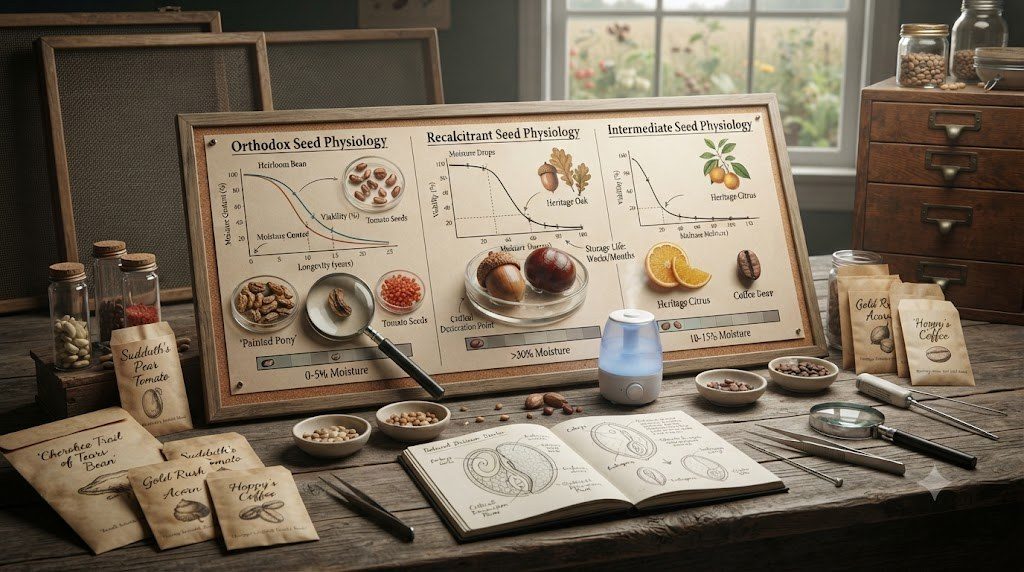
- Orthodox Seeds: Capable of withstanding severe dehydration down to 3%–7% fresh weight moisture content (water potential < -150 MPa) without losing viability. Once dried, their longevity increases predictably with decreasing moisture content and storage temperature according to Harrington's Rules of Thumb and the Ellis-Roberts Viability Equation. Examples include major temperate crops: wheat, rice, barley, peas, soybeans, brassicas, and tomato.
- Recalcitrant (Desiccation-Sensitive) Seeds: Incapable of surviving drying below high critical water contents (often 25%–40% fresh weight, water potential > -5 MPa) and highly susceptible to chilling injury when exposed to temperatures below 10°C–15°C. They undergo no maturation drying on the parent plant and are shed in a metabolically active, hydrated state. Examples include major tropical rainforest trees and economic perennials: rubber (Hevea brasiliensis), cocoa (Theobroma cacao), mango (Mangifera indica), avocado (Persea americana), and oak (Quercus species).
- Intermediate Seeds: Exhibit characteristics bridging the two extremes. They tolerate desiccation down to intermediate levels (around 10%–12% moisture content) but suffer severe viability loss and membrane degradation when stored at sub-zero temperatures (-20°C). Examples include Arabica coffee (Coffea arabica), papaya (Carica papaya), neem (Azadirachta indica), and oil palm (Elaeis guineensis).
2. Desiccation Tolerance Mechanisms: LEA Proteins and Vitrification
The biological ability of orthodox seeds to survive the removal of almost all cellular water relies on a coordinated molecular shield deployed during late embryogenesis (maturation drying):
Late Embryogenesis Abundant (LEA) Proteins: LEA proteins are intrinsically disordered, hydrophilic, non-globular polypeptides that accumulate in vast quantities during seed maturation. In their hydrated state, they exhibit random coil conformations. However, as cellular water evaporates, LEA proteins undergo conformational folding into amphipathic alpha-helices. In this state, they act as molecular chaperones, binding to partially unfolded structural proteins, preventing hydrophobic aggregation, and shielding cellular membranes from mechanical collapse.
Non-Reducing Disaccharides and RFOs: Orthodox seeds accumulate massive concentrations of the non-reducing disaccharide sucrose alongside Raffinose Family Oligosaccharides (RFOs)—specifically raffinose, stachyose, and verbascose. These non-reducing sugars replace water molecules at biological membranes (the Water Replacement Hypothesis), forming hydrogen bonds directly with the hydrophilic phosphate headgroups of phospholipids. This maintains membrane fluidity, prevents liquid-crystalline-to-gel phase transitions, and precludes catastrophic solute leakage upon rehydration.
3. Why Recalcitrant Seeds Die Upon Drying: Metabolic and Mechanical Lysis
Recalcitrant seeds completely lack the genetic and biochemical programs required to synthesize LEA proteins, RFOs, and heat-shock proteins during seed development. When recalcitrant seeds are subjected to drying, they succumb to two lethal, sequential failure modes:
1. Desiccation-Induced Metabolic Disruption: Unlike orthodox seeds, recalcitrant seeds do not shut down respiration upon shedding; their mitochondria maintain active electron transport and ATP synthesis. When water is extracted, metabolic pathways become uncoupled. Univalent reduction of oxygen leads to massive bursts of toxic Reactive Oxygen Species (ROS)—including superoxide radicals (O2•-), hydrogen peroxide (H2O2), and hydroxyl radicals (•OH). Lacking sufficient antioxidant enzymes (superoxide dismutase, catalase, ascorbate peroxidase), these ROS attack membrane polyunsaturated fatty acids, inducing rampant lipid peroxidation, protein carbonylation, and DNA strand fragmentation.
2. Mechanical Cell Wall Collapse: In hydrated plant cells, internal turgor pressure supports cellular geometry. In recalcitrant tissues, water removal causes vacuoles to shrink violently. Because cell walls lack the structural flexibility and protective LEA buffers found in orthodox tissues, the collapsing plasma membrane tears away from the rigid cell wall, causing irreversible physical lysis of the protoplast.
| Physiological Parameter | Orthodox Seed Behavior | Recalcitrant Seed Behavior | Intermediate Seed Behavior |
|---|---|---|---|
| Maturation Drying Phase | Present (systematic water loss on parent) | Completely absent; shed fully hydrated | Partial maturation drying present |
| Safe Moisture Level | 3% - 7% Fresh Weight | Lethal at < 25% - 35% Fresh Weight | 9% - 12% Fresh Weight |
| Sub-Zero Storage (-20°C) | Survives decades to centuries | Immediate lethal freezing injury | Viability drops rapidly within months |
| Metabolic State at Shedding | Quiescent (metabolic shutdown) | Active respiration & organelle turnover | Low to intermediate metabolic flux |
| Glass Formation (Vitrification) | Forms stable glassy state readily | Incapable of vitrification; crystals form | Forms unstable, brittle glasses |
| Major Representative Crops | Wheat, Soybean, Rice, Tomato, Onion | Cocoa, Avocado, Mango, Rubber, Oak | Coffee, Papaya, Oil Palm, Citrus |
4. Global Conservation Strategies: The Cryopreservation Frontier
The divergent physiology of seed storage poses monumental challenges for global biodiversity conservation. Orthodox crop wild relatives and landraces can be preserved indefinitely in conventional seed vaults—such as the Millennium Seed Bank at Kew or the Svalbard Global Seed Vault—at -18°C to -20°C with 15% relative humidity.
However, recalcitrant and intermediate seeds cannot be preserved in conventional seed vaults. Preserving recalcitrant germplasm requires cutting-edge cryopreservation protocols. Because whole recalcitrant seeds are too large and wet to freeze without lethal intracellular ice crystal formation, scientists excise the microscopic embryonic axis (0.5 to 1.5 mm in size). These excised axes are treated with high-concentration cryoprotectant vitrification solutions (such as PVS2: plant vitrification solution containing glycerol, ethylene glycol, and DMSO) to induce artificial vitrification, before being plunged directly into liquid nitrogen at -196°C.
Cryopreservation success depends critically on achieving ultra-rapid cooling and warming rates (exceeding 200°C to 500°C per minute). Such extreme thermal flux circumvents ice crystallization entirely, transitioning cellular water directly into a metastable glass. Following liquid nitrogen immersion, embryonic axes are recovered via rapid rewarming in a 40°C water bath, followed by systematic unloading in liquid sucrose solutions (1.2 M) to prevent severe osmotic shock. The rescued embryos are subsequently transferred to optimized plant tissue culture media supplemented with specific auxin and cytokinin ratios (such as benzylaminopurine and naphthaleneacetic acid) to induce embryonic axis elongation and adventitious root organogenesis under sterile laminar flow conditions.
5. Harrington's Rules of Thumb and the Ellis-Roberts Viability Equation
For orthodox seed lots, seed longevity is mathematically predictable based on moisture and thermal parameters. In 1972, seed technologist James Harrington established two widely utilized operational axioms known as Harrington's Rules of Thumb:
- Rule 1 (Moisture Factor): For every 1% decrease in seed moisture content (within the range of 5% to 14%), the storage life of orthodox seeds is doubled.
- Rule 2 (Temperature Factor): For every 5°C (10°F) reduction in storage temperature (within the range of 0°C to 50°C), the storage life of orthodox seeds is doubled.
- Rule 3 (The Combined Index): The sum of the storage temperature (in degrees Fahrenheit) plus the relative humidity percentage should not exceed 100 for safe agricultural seed storage (e.g., 50°F + 50% RH = 100).
In modern seed banking, Harrington's rules are formalized into the universal Ellis and Roberts Seed Viability Equation:
v = K_i - (p / 10^(K_E - C_w × log10(m) - C_H × t - C_Q × t^2))
Where v is seed viability in probits after storage period p, K_i is the initial seed lot viability, m is seed moisture content, t is storage temperature in Celsius, and K_E, C_w, C_H, and C_Q are species-specific seed viability constants.
Frequently Asked Questions (FAQ)
Q: Why can't recalcitrant seeds like avocado and mango be dried for storage?
Recalcitrant seeds lack the genes to produce Late Embryogenesis Abundant (LEA) proteins and protective Raffinose Family Oligosaccharides. When dried, their cell walls collapse mechanically, and their uncoupled mitochondria produce lethal bursts of reactive oxygen species that destroy cell membranes.
Q: What happens to orthodox seeds if they are dried below 3% moisture content?
Over-drying orthodox seeds below 2% to 3% moisture content strips the fundamental monomolecular layer of water bound to essential enzymes and structural proteins. This induces lipid autoxidation, enzyme denaturation, and structural cracking upon rehydration.
Q: Why is coffee classified as an intermediate seed rather than orthodox?
Arabica coffee seeds can be dried safely to 10% moisture content, but when exposed to standard seed-vault freezing temperatures of -20°C, their membrane lipids undergo lethal phase separations, causing rapid viability loss within weeks.
Q: What is the physiological role of Late Embryogenesis Abundant (LEA) proteins?
LEA proteins are intrinsically disordered, hydrophilic polypeptides that fold into amphipathic alpha-helices upon water loss. They act as molecular shields, binding to vulnerable proteins to prevent aggregation and protecting membranes during desiccation.
Q: How are recalcitrant tree species preserved long-term if seed banking fails?
Recalcitrant species are preserved in living field genebanks, botanical arboretums, in vitro tissue culture collections, or via cryopreservation—excising microscopic embryonic axes, treating them with vitrification chemicals, and storing them in liquid nitrogen at -196°C.
Q: Why does Harrington's Rule of Thumb fail above 14% seed moisture content?
Above 14% moisture content, free water enables seed respiration and fungal spore germination. Rapid cellular heating, mold proliferation (Aspergillus and Penicillium), and enzymatic self-destruction occur, invalidating linear life-doubling models.
Q: What is intracellular vitrification and why is it crucial for seed survival?
Vitrification is the physical transition of a concentrated liquid solution into an amorphous, non-crystalline glass-like solid without forming ice crystals. It halts molecular diffusion and chemical reactions, preserving cellular architecture for centuries.
Q: Why do oak acorns rot or die if stored in a standard household freezer?
Acorns are recalcitrant seeds containing high moisture (over 35%). Freezing them causes free water inside cells to expand into sharp ice crystals, mechanically puncturing cell membranes, rupturing organelles, and killing the embryo instantly.
Q: Can non-reducing sugars like raffinose be used as a spray to make seeds orthodox?
No. Desiccation tolerance requires complex coordinated intracellular synthesis, active organelle restructuring, chromatin condensation, and targeted deposition of sugars and LEA proteins inside the nucleus, cytoplasm, and vacuolar membranes.
Q: What is the difference between physiological seed death and physical seed dormancy?
Physiological seed death is the permanent, irreversible destruction of cellular membranes, DNA, and metabolic enzymes. Physical dormancy is a reversible adaptive survival state where a viable, living seed refuses to germinate due to impermeable coats or hormonal blocks.
Q: Why are tropical rainforest trees predominantly recalcitrant?
Tropical rainforests provide year-round moisture, stable warm temperatures, and high humidity. In the absence of seasonal drought or freezing winters, evolutionary selection favored immediate germination over the energetic expense of synthesizing desiccation shields.
Q: How does moisture content affect seed respiration rate during storage?
Between 5% and 10% moisture, respiration is virtually undetectable. As moisture rises above 13%, mitochondrial respiration increases exponentially, consuming food reserves, generating heat, and releasing water vapor that accelerates deterioration.
Q: What are the four Ellis-Roberts constants in seed viability equations?
The constants are K_E (species baseline longevity), C_w (logarithmic moisture sensitivity factor), C_H (linear temperature sensitivity factor), and C_Q (quadratic temperature sensitivity factor), derived from accelerated aging trials.
Q: How does seed size correlate with recalcitrant versus orthodox physiology?
Recalcitrant seeds tend to be significantly larger and heavier (often > 1 to 50 grams, such as coconuts, mangoes, and oak acorns) because large seed masses dry slowly in nature, allowing the plant to invest in massive hydrated reserves rather than desiccation protection. Orthodox seeds are generally smaller and dry rapidly.
Q: What is the role of the Glass Transition Temperature (Tg) in seed longevity?
The Glass Transition Temperature (Tg) is the critical temperature threshold below which a concentrated sugar-protein solution forms a stable glassy matrix. If storage temperatures rise above Tg, the intracellular glass melts into a viscous rubbery fluid, accelerating chemical reactions and causing rapid viability loss.